The Weight of Memory
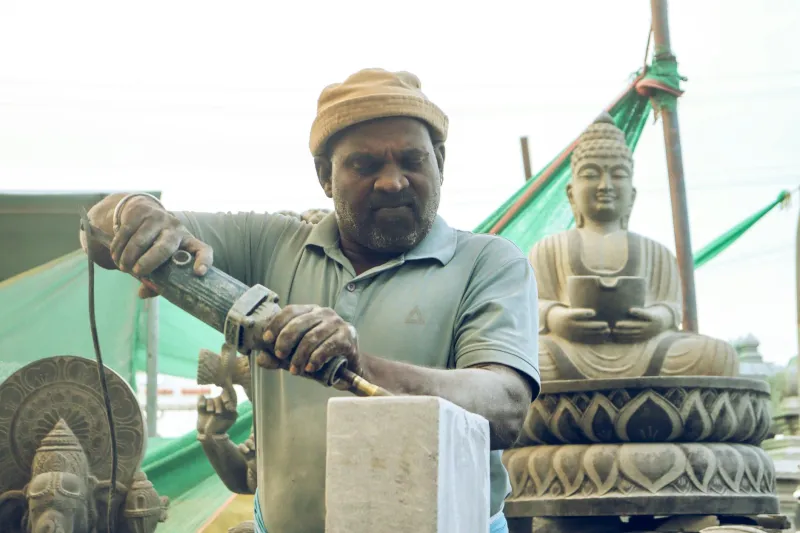
In a workshop tucked behind Machynlleth's main street, Gareth Williams runs his finger along a piece of Welsh slate, feeling for the grain that will guide his chisel. The memorial he's preparing will join thousands of others across Wales, each letter carved by hand using techniques his grandfather taught him forty years ago. "Every stone tells you how it wants to be cut," he says, selecting a well-worn tool from the rack beside his bench. "You can't rush slate. It remembers every mistake."
Williams is part of a quietly devoted community scattered across Britain's villages and market towns, keeping alive one of our oldest forms of permanent communication. While the digital world races past outside, these letter-cutters work at the pace of stone itself, creating inscriptions that will outlast governments, technologies, and perhaps even the buildings they adorn.
Ancient Skills, Living Hands
The craft of monumental lettering stretches back to Roman Britain, but its modern practitioners trace their lineage through medieval stonemasons who carved everything from church fonts to market crosses. Today's letter-cutters inherit not just techniques, but responsibility — they are the custodians of how we choose to be remembered.
In the Yorkshire Dales, Sarah Bramley learned her trade through a seven-year apprenticeship that began with months of just watching. "My master would say, 'The stone knows when you're ready,'" she recalls, adjusting her position at the workbench where she's cutting letters into a piece of local limestone. "I thought he was being mystical, but after a while you understand. The stone does tell you things — how deep to go, where the natural breaks are, whether your angle is true."
Bramley's workshop overlooks fields where sheep graze between dry stone walls, many of which bear carved boundary stones dating back centuries. This continuity matters to her work. "When I'm cutting a memorial for someone's grandmother, I'm using the same movements, the same relationship with the stone, as the mason who carved the church tower she walked past every day for eighty years."
Regional Dialects in Stone
Just as spoken language varies across Britain, so does the language of carved letters. Cornish granite demands different techniques from Cotswold limestone, while Welsh slate responds to tools and rhythms all its own. These aren't merely technical differences — they reflect distinct cultural approaches to permanence and memory.
In Tavistock, Devon, Tom Perkins specialises in what he calls "West Country curves" — the flowing, organic letter forms that evolved to complement the area's soft, honey-coloured stone. "Devon letters want to breathe," he explains, demonstrating the gentle arc of an 'S' that seems to grow naturally from the rock. "Force them into rigid shapes and they look foreign, like they've been dropped here from somewhere else."
This regional character extends beyond aesthetics to meaning. Northern letter-cutters often favour bold, direct inscriptions that mirror the landscape's stark honesty. Welsh practitioners integrate ancient Celtic forms that connect contemporary memorials to Bronze Age carved stones. Scottish craftspeople work with granite that demands precision but rewards it with inscriptions that can survive Highland winters for centuries.
The Rhythm of Remembrance
Watch a skilled letter-cutter at work and you witness something approaching meditation. Each tap of the chisel follows a rhythm older than machinery, a conversation between human intention and geological patience. The sound echoes in workshops from Orkney to Cornwall — a percussion section in Britain's ongoing cultural symphony.
"People think we're just carving words," says Margaret Ross, whose Aberdeen workshop has been cutting granite memorials for three generations. "But we're really carving time itself. Every letter is a small victory over forgetting."
Ross learned from her father, who learned from his uncle, in an unbroken chain reaching back to the 1890s. Her hands know the weight of Scottish granite, the precise angle needed to prevent the stone from chipping, the patience required to achieve the clean, sharp edges that will catch light and shadow for generations.
Modern Challenges, Ancient Solutions
Today's letter-cutters face pressures their predecessors never imagined. Machine-cut memorials offer cheaper alternatives, while changing funeral practices reduce demand for traditional headstones. Yet many practitioners report unexpected sources of renewal.
"Young people are rediscovering handmade things," observes David Fletcher, who runs courses in letter-cutting from his Shropshire workshop. "They've grown up with screens and pixels, but there's something about permanent marks in stone that speaks to them. Maybe it's the opposite of social media — instead of disappearing after a few seconds, these letters will outlive us all."
Fletcher has noticed growing interest in carved house signs, garden memorials, and commemorative stones for community projects. His students include software developers seeking tactile creativity, retired teachers wanting to learn traditional skills, and young parents hoping to pass something enduring to their children.
Keepers of the Craft
The letter-cutters of Britain work largely in solitude, but they form an informal network bound by shared knowledge and mutual respect. They recommend each other for commissions, share techniques refined over decades, and quietly ensure that ancient skills survive in modern hands.
At village fairs and heritage demonstrations, they invite the public to try their hand at carving simple letters, watching as children and adults alike discover the satisfying resistance of stone giving way to patient pressure. These moments plant seeds — not everyone will become a letter-cutter, but everyone leaves understanding why the craft matters.
Writing the Future
As Britain's letter-cutters continue their quiet work, they're not just preserving the past — they're actively writing the future. Every memorial they carve, every commemorative stone they letter, every apprentice they train adds another chapter to a story that began when humans first realised they could make permanent marks in stone.
In workshops across the country, the sound of chisel meeting stone continues — a rhythm as essential to British culture as the tick of church clocks or the call of curlews over moorland. These craftspeople understand something the digital age sometimes forgets: the deepest human need isn't for information, but for permanence. In a world of temporary messages and fleeting connections, they offer something more enduring — words carved so deeply into stone that time itself must work centuries to erase them.