When Strangers Come Calling
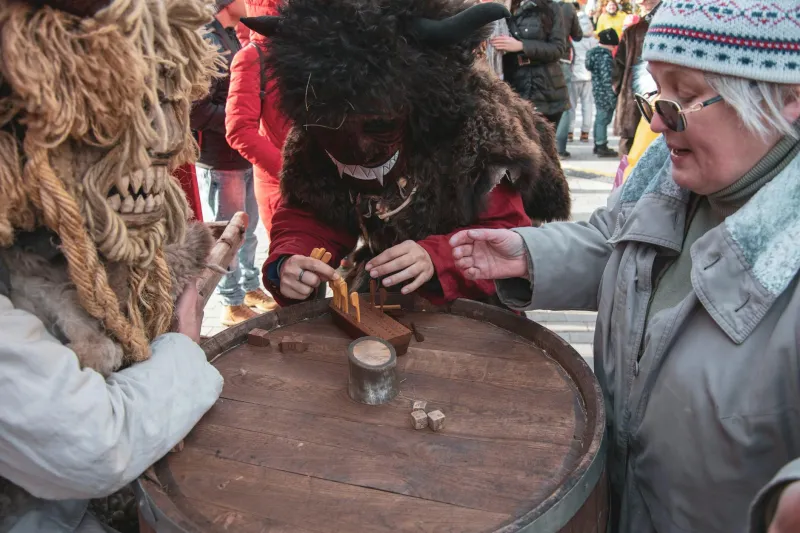
There's something unsettling about opening your door to find a group of masked figures waiting on the threshold, their faces painted or hidden behind crude disguises, ready to push past you into your home uninvited. Yet for centuries across Britain, this is exactly what happened each midwinter, when bands of mummers would arrive at doorsteps and pub entrances to perform their peculiar death-and-resurrection dramas.
Today, in an age of ring doorbells and stranger danger, the mummers' tradition might seem like a relic from a more trusting time. But across England, Wales, and Ireland, a new generation of performers is discovering that these ancient rituals speak to something deeper than nostalgia—they're tapping into fundamental human needs for community disruption, seasonal marking, and the confrontation with mortality that our sanitised modern lives often lack.
The Ancient Art of Interruption
The mummers' play is theatre stripped to its most elemental form. There's always a hero—often Saint George or a local champion—who faces a challenger. Death follows, sometimes messily, sometimes with deliberate absurdity. Then comes resurrection, usually at the hands of a comic doctor character whose cure-all remedies range from the sublime to the ridiculous. The whole performance rarely lasts more than ten minutes, but within that brief span lies a complete cosmological cycle.
"It's not really about entertainment in the way we understand it now," explains Sarah Whitworth, who's been researching mummers' traditions across the West Country for over a decade. "These performances were interruptions—they broke the normal flow of daily life to remind communities of larger rhythms. Death, rebirth, the turning of the year."
The tradition's roots stretch back into pre-Christian Britain, though the plays themselves evolved constantly, absorbing everything from medieval mystery plays to contemporary political satire. By the Victorian era, they were often bawdy affairs, with performers using the license of disguise to mock local figures and social conventions.
Surviving the Centuries
What's remarkable isn't that mummers' plays existed, but that they survived at all. Unlike morris dancing or folk singing, which found champions among the educated classes during the folk revival movement, mumming remained stubbornly working-class and local. The plays were passed down through families and communities, often changing dramatically from one generation to the next.
In many places, the tradition died out entirely during the twentieth century, casualties of urbanisation, television, and changing social attitudes. But in others—particularly in rural areas of Yorkshire, Lancashire, and the West Country—the mummers never stopped calling.
"My grandfather was a mummer, and his grandfather before him," says Tom Bradley, who leads a troupe in the Yorkshire Dales. "We never thought of it as heritage or tradition—it was just what we did at Christmas. You'd go round the farms and the pub, earn a bit of pocket money, have a laugh."
The New Mummers
But today's mummers aren't just carrying on family traditions. Across Britain, new troupes are forming, often led by people with no ancestral connection to the practice but drawn to its raw, unpolished energy. These modern mummers are discovering that the tradition's apparent crudeness is actually its strength.
"There's something liberating about mumming," says Helen Cartwright, who started a troupe in Brighton five years ago. "It's not precious like some traditional arts can be. It's meant to be a bit rough, a bit chaotic. That's the point—you're breaking into people's comfortable spaces and shaking things up."
Cartwright's troupe performs a hybrid play that combines traditional elements with contemporary concerns—their doctor character peddles cures for everything from Brexit anxiety to social media addiction. It's exactly the kind of evolution that has always kept mumming alive.
The Psychology of the Threshold
What draws people to this strange, disruptive tradition? Dr. Marcus Webb, a folklorist at the University of Sheffield, believes mumming taps into deep psychological needs that modern life often neglects.
"The threshold is a powerful space in human psychology," he explains. "It's where inside meets outside, familiar meets strange, safe meets dangerous. The mummers deliberately occupy this liminal space, and in doing so, they create a moment where normal rules are suspended."
This suspension of normality serves multiple functions. For performers, the masks and disguises offer freedom from everyday social constraints. For audiences, the plays provide a controlled encounter with death and renewal that our death-phobic culture rarely allows.
Darkness Before Light
Perhaps most importantly, mumming acknowledges darkness. Unlike Christmas celebrations that focus relentlessly on joy and light, the mummers' plays begin with conflict, violence, and death. Only then comes resurrection, and it's often tentative, comic, or incomplete.
"We live in a culture that wants to skip straight to the happy ending," observes Whitworth. "But the mummers understand that you can't have renewal without acknowledging what needs to die first. That's why these plays feel so powerful—they don't shy away from the difficult bits."
As Britain faces its own dark season—economic uncertainty, social division, climate anxiety—perhaps it's not surprising that more people are drawn to a tradition that embraces disruption and finds hope not in denial but in the promise that even death is not final.
Keeping the Door Open
The mummers at your door aren't asking for much—just a few minutes of your time, a small donation, perhaps a drink to warm them before they move on to the next threshold. In return, they offer something increasingly rare: a genuine surprise, a moment of strangeness, a reminder that the world is larger and stranger than our daily routines suggest.
As Tom Bradley puts it: "People always seem surprised when we turn up, but they're pleased too. Like they've been waiting for something to happen, even if they didn't know what."
In a world of planned entertainment and scheduled spontaneity, perhaps that's the mummers' greatest gift—the art of the unexpected knock, the stranger at the threshold, the ancient promise that even in the deepest darkness, something new is always trying to be born.