The Sound That Won't Stay Silent
In a cramped workshop above a charity shop in Barnsley, Steve Turner holds up what looks like a small leather briefcase crossed with a church organ. "People think it's an accordion," he says, flexing the hexagonal instrument between his hands. "But this is something entirely different. This is a concertina, and it's got a voice that cuts straight through to your bones."
Turner is one of Britain's last traditional concertina makers, and he's busier than he's been in decades. Orders are coming in from folk musicians across the country, from teenage Morris dancers in the Cotswolds to retired fishermen in Aberdeen. After nearly vanishing from Britain's musical landscape, the concertina is experiencing what can only be called a renaissance—quiet, perhaps, but unmistakably real.
From Parlour to Pub: A Victorian Success Story
The concertina arrived in Britain in the 1840s, the brainchild of Sir Charles Wheatstone, a physicist who was tinkering with ways to make music more portable. Unlike its cousin the accordion, which uses simple button systems, the concertina employs a complex arrangement of individual reeds, each precisely tuned. The result is an instrument capable of extraordinary expression—from the delicate tracery of an Irish air to the driving rhythm of a sea shanty.
By the 1880s, concertinas were everywhere. They graced Victorian drawing rooms, accompanied hymn singing in Methodist chapels, and provided the soundtrack for countless Saturday night knees-ups. Sailors carried them to sea, knowing that salt air and cramped quarters demanded something more robust than a violin, more intimate than a piano.
"It was the people's instrument," explains Dr. Sarah Mitchell, who runs concertina workshops at Cecil Sharp House in London. "Small enough to carry, loud enough to fill a room, and expressive enough to make people weep. What more could you ask for?"
The Long Silence
But by the 1950s, the concertina had largely disappeared from British musical life. The rise of recorded music, television, and electric instruments pushed acoustic folk music to the margins. The instrument's association with an older generation didn't help—young people wanted guitars, not their grandparents' squeeze-boxes.
For decades, the concertina survived mainly in Ireland, where it remained central to traditional music sessions. In Britain, it became something of a curiosity, wheeled out for period dramas or folk festivals that prided themselves on authenticity.
New Hands, Old Voices
Something changed around the turn of the millennium. Perhaps it was the growing interest in traditional crafts, or maybe the search for authentic experiences in an increasingly digital world. Whatever the cause, young musicians began discovering the concertina's unique voice.
Take Emma Clarke, a 28-year-old software developer from Brighton who took up the concertina three years ago. "I'd been playing guitar for years, but there was something missing," she explains over a pint at her local session. "When I heard someone play 'The Parting Glass' on concertina, it was like hearing the song for the first time. There's an intimacy to it, a directness that other instruments can't match."
Clarke represents a new generation of concertina players who are approaching the instrument without the weight of tradition. They're experimenting with contemporary songs, incorporating the concertina into indie folk bands, and using social media to share techniques and repertoire.
The Regional Voices
One of the concertina's great strengths is its adaptability to regional styles. In the North East, players favour the robust, rhythmic approach that powered the region's folk clubs. Scottish players have developed techniques that complement the country's fiddle tradition, while in Cornwall, the instrument has found a home in the revival of traditional dance music.
"Each area has its own accent," notes Turner from his Barnsley workshop. "A Suffolk player sounds different from someone from Yorkshire, just like their speaking voices. The instrument adapts to the character of the place."
This regional variation is being preserved and documented by groups like the International Concertina Association, which organises workshops and festivals across the country. Their annual gathering in Witney, Oxfordshire, brings together players from across Britain and Ireland, creating a space where techniques and tunes are shared across generations.
The Makers Keep Making
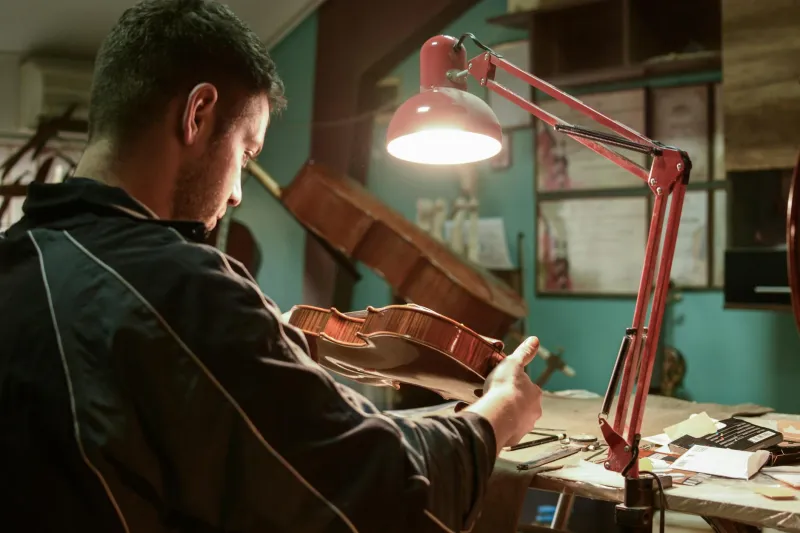
Behind the revival are the craftspeople who keep the instruments alive. Turner learned his trade from Frank Butler, one of the last makers to serve an apprenticeship with the old firms. Now in his seventies, Turner is passing his knowledge to a new generation of makers who combine traditional techniques with modern materials.
"Each instrument has its own personality," he explains, adjusting a reed with a tool that looks like it belongs in a watchmaker's kit. "The wood, the leather, the way the reeds are set—it all affects the voice. I'm not just making an instrument; I'm creating something that will outlive me, something that will carry songs into the future."
The Sessions Continue
Perhaps the most encouraging sign of the concertina's revival is its return to the session scene. In pubs from Penzance to Perth, the distinctive wheeze and sigh of the concertina is once again providing the heartbeat for traditional music gatherings.
At the Crown and Anchor in Eastbourne, the monthly folk session regularly features three concertina players, ranging in age from 19 to 78. "It's not about showing off," says session leader Tom Brennan. "It's about keeping the conversation going, the musical conversation that's been happening in British pubs for centuries."
The concertina's revival isn't flashy or commercial. There are no concertina rock stars or viral YouTube videos. Instead, it's a grassroots movement driven by people who understand that some voices, once lost, are worth fighting to recover. In village halls and music shops, in workshops and sessions, the concertina is finding its way back to the heart of Britain's musical life—one squeeze at a time.