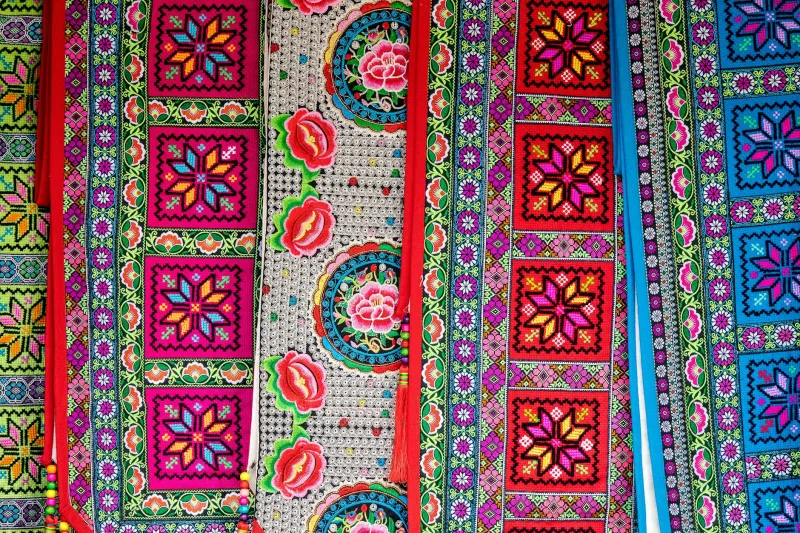
In a converted Methodist chapel in the Brecon Beacons, Sarah Williams runs her fingers across the rough wool of a traditional Welsh tapestry blanket. The geometric patterns—bold stripes of indigo and scarlet—seem to pulse with their own rhythm, each thread a note in a song that's been playing for centuries.
"My grandmother would have laughed to see me here," Sarah admits, adjusting the tension on her loom. "She thought these old ways would die with her generation. But here we are, thirty-somethings queuing up to learn what she considered ordinary household skills."
Sarah's workshop is part of a quiet revolution sweeping across Britain. From the Highlands to the Cornish coast, textile traditions that seemed destined for museum displays are finding new life in the hands of makers who understand their deeper significance.
The Language of Cloth
Textiles have always been Britain's unsung storytellers. In the pit villages of County Durham, miners' wives transformed worn work clothes into intricate quilts that served as both bedding and family chronicles. Each patch carried memory—a child's outgrown dress, a husband's Sunday shirt, fabric from a wedding or christening gown.
"These weren't just practical items," explains Dr. Margaret Thornton, a textile historian at Newcastle University. "They were repositories of community memory, ways of preserving and sharing stories when literacy wasn't universal."
The tradition runs deep. Welsh blanket weavers developed patterns that identified their valleys as surely as accents. Scottish islanders created Fair Isle jumpers with motifs that spoke of wind and wave. English country quilters gathered in circles that functioned as informal news networks, their needlework sessions weaving together both fabric and community bonds.
New Hands, Ancient Wisdom
Today's revival isn't driven by nostalgia alone. At Fabrications, a community textile space in Manchester's Northern Quarter, twenty-eight-year-old Maya Patel leads workshops in traditional British quilting techniques. Her students range from university graduates to retired teachers, united by something deeper than hobby interest.
"There's something about working with your hands that feels radical now," Maya observes, watching a group piece together a collaborative quilt. "In a world of screens and algorithms, these crafts connect you to something real, something rooted."
The digital age, paradoxically, has helped fuel the revival. Online communities share patterns passed down through generations, while Instagram accounts document the meditative process of hand-stitching. The hashtag #BritishTextileHeritage has become a rallying point for makers sharing everything from Orkney chair covers to Cornish fishing smocks.
Regional Rhythms
Each corner of Britain speaks its own textile dialect. In the Scottish Borders, the Selkirk Guild of Weavers has seen membership triple in five years as young makers discover the satisfaction of working with local wool on traditional looms. Their president, James MacLeod, notes the hunger for authenticity among newcomers.
"They don't want mass-produced approximations," he says. "They want to understand the why behind the patterns, the stories embedded in the stitches."
In Wales, the revival of traditional blanket weaving has sparked new interest in natural dyeing techniques. Workshops at the National Wool Museum teach participants to extract colours from plants their ancestors would have gathered—madder root for red, weld for yellow, indigo for the deep blue that defined Welsh textiles.
The Stitch in Time
What makes this revival particularly compelling is its embrace of imperfection. Unlike machine production, hand-crafted textiles carry the maker's signature in every slightly uneven stitch, every subtle colour variation. These "flaws" are increasingly seen as features, markers of human touch in an automated world.
At the Durham Heritage Centre, volunteers work on recreating a Victorian friendship quilt, each contributor adding their own square to a pattern that will take months to complete. The process mirrors the original—community members gathering, sharing stories, creating something beautiful together.
"It's not about efficiency," explains volunteer coordinator Helen Barnes. "It's about connection—to each other, to our history, to the rhythms of making that sustained communities for generations."
Stitching Forward
The movement extends beyond traditional techniques to embrace contemporary concerns. Climate-conscious makers champion textile traditions as sustainable alternatives to fast fashion. Zero-waste quilting techniques that transformed every scrap into something useful suddenly feel urgently relevant.
Young designers are also finding inspiration in heritage patterns, translating traditional motifs into contemporary contexts. The geometric precision of Welsh blankets appears in modern wall hangings, while Fair Isle patterns find new expression in everything from phone cases to architectural installations.
As Sarah Williams completes another row on her loom, she reflects on what draws her generation to these ancient crafts. "We've lost so much connection to the physical world," she muses. "But when you're working with wool that came from sheep grazing on the hills outside your window, using patterns your great-grandmother might have known, you feel part of something continuous. Something that won't disappear into the cloud."
In village halls and urban studios across Britain, the quiet revolution continues. Thread by thread, stitch by stitch, a new generation is ensuring that the stories woven into our textile heritage will continue to unfold for generations to come.