Hands That Remember
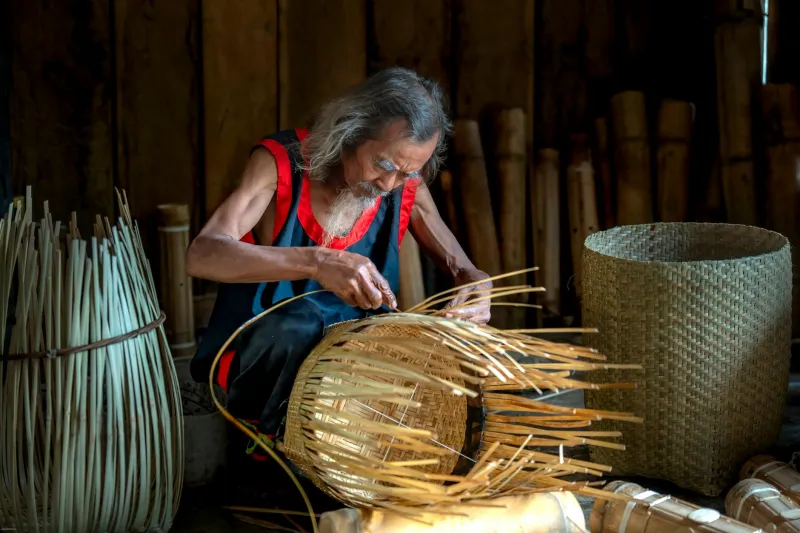
In a converted barn outside Bridgwater, Sarah Munt's fingers move through Somerset willow with the certainty of inherited knowledge. Each rod tells a story—where it grew, when it was cut, how the winter floods shaped its grain. She doesn't think about these things consciously anymore; thirty years of basket-making have taught her to read landscape through touch alone.
"People think basket-making is about technique," she says, selecting another rod from the pile beside her feet. "But really, it's about conversation. You're talking to the plant, to the land that grew it, to everyone who's done this work before you."
This conversation has been continuing across Britain for millennia, spoken in a language of bent wood and woven grass that predates written history. Yet far from being a relic, traditional basket-making is experiencing something approaching renaissance, as a new generation discovers what their ancestors always knew: that the most enduring objects come from the closest relationships with place.
The Somerset Difference
Somerset's Levels have shaped baskets for over a thousand years, their particular geography creating conditions perfect for growing the finest basket willow in Europe. The annual floods that frustrate farmers provide exactly the moisture and silt that willow demands, while the flat terrain allows mechanical harvesting that keeps costs manageable.
"Somerset willow is different from anything else," explains James Cook, whose family farm near Langport has grown basket willow for four generations. "The floods give it strength, but also flexibility. You can bend it further before it breaks. Continental willow looks similar, but it doesn't behave the same way."
This specificity of place extends beyond growing to making. Somerset basket-makers developed techniques—particularly around the famous Somerset trap—that exploit their local material's particular qualities. The result is baskets that look distinctively English: sturdy, functional, beautiful in their restraint.
Highland Alternatives
A thousand miles north, in the scattered crofts of Sutherland, Margaret MacLeod works with entirely different materials toward surprisingly similar ends. Her baskets emerge from Highland heather, bog cotton, and marram grass—plants that would puzzle a Somerset maker but make perfect sense in their own context.
"Everything we needed was here," she explains, gathering heather from the hillside behind her cottage. "Why would you import willow when you've got all this?"
Her baskets—tight-woven creels for carrying peat, loose fish baskets designed to drain on the beach, delicate vessels for holding eggs—reflect the Highland landscape's demands. Each form evolved for specific purposes: carrying seaweed up cliff paths, storing oats through winter, transporting live lobsters to market.
The techniques differ radically from Somerset's rod-and-stake construction. Highland baskets often use coiling methods that build spirally from the base, or stake-and-strand approaches that create remarkably strong structures from surprisingly delicate materials.
Welsh Variations
In the valleys of Powys, David Williams represents a third tradition entirely. His baskets emerge from Welsh hazel and ash, materials that grow abundantly in the steep-sided valleys but require entirely different handling from either Somerset willow or Highland heather.
"Welsh baskets were always about the hills," he explains, demonstrating the split-oak technique that creates his distinctive rectangular harvest baskets. "You needed something that could handle rough ground, that wouldn't break when you're scrambling up a mountainside with forty pounds of potatoes."
Welsh basket-making developed its own vocabulary of forms: the distinctive 'cwrwgl' or coracle basket that doubled as both container and boat frame; the tall, narrow baskets designed for carrying slate from quarry to cart; the beautifully proportioned shopping baskets that became status symbols in Victorian market towns.
The New Makers
Today's basket-makers come to the craft through various routes, but all share a hunger for direct relationship with materials and place. Some, like Emma Johnson in the Norfolk Broads, learned from elderly practitioners before traditional knowledge disappeared entirely. Others, like Tom Richards in the Yorkshire Dales, discovered basket-making through environmental concerns, seeking alternatives to plastic containers.
"I started because I was fed up with buying storage boxes that would break and end up in landfill," Richards explains, working on a sturdy log basket from locally-coppiced ash. "But once you start, you realise you're plugging into something much deeper. This knowledge connects you to your landscape in ways you never expected."
The new makers often combine traditional techniques with contemporary needs, creating baskets for modern life while maintaining ancient principles. Bicycle panniers woven from Somerset willow; laptop cases crafted from Scottish rushes; wine carriers that showcase traditional Welsh construction methods.
Reading the Landscape
What unites all these regional traditions is their intimate relationship with specific places. A Somerset basket-maker can read flood patterns in willow grain; a Highland weaver knows which hillsides produce the strongest heather; a Welsh craftsperson understands how valley orientation affects ash growth.
This knowledge represents a form of literacy often overlooked in discussions of traditional skills—the ability to read landscape as text, understanding how geology, climate, and ecology combine to create materials with particular properties.
"You can't separate the basket from the place that grew its materials," observes Dr. Helen Morrison, who studies traditional crafts at the University of Wales. "Each basket carries information about rainfall, soil type, seasonal patterns. They're like three-dimensional maps of their landscapes."
Continuity and Change
Modern basket-makers face challenges their predecessors couldn't have imagined. Climate change affects growing patterns; urbanisation reduces access to traditional materials; cheap imports undercut handmade products. Yet the craft persists, adapted but essentially unchanged.
Some makers now grow their own materials, recreating traditional relationships between cultivation and craft. Others work with conservation organisations, managing woodlands and wetlands while harvesting sustainable materials. A few have embraced technology, using social media to share techniques and connect isolated practitioners.
"The fundamentals don't change," says Sarah Munt, beginning work on another Somerset basket. "You still need to understand your materials, respect your tools, take time to do things properly. The rest is just details."
Objects of Memory
In an age of mass production, handmade baskets carry weight beyond their practical function. Each one represents hours of human attention, intimate knowledge of place, and continuity with ancestral practice. They're objects that remember—not just their making, but the landscapes that shaped their materials and the communities that developed their forms.
When you hold a traditional British basket, you're touching more than woven plant fibres. You're connecting with generations of makers who understood that the most enduring human creations emerge from the deepest relationships with place, that true craft lies not in imposing human will upon materials but in discovering what those materials want to become.
The conversation continues, spoken in languages older than words, written in patterns that carry the memory of these islands in their very structure.