Between Warp and Weft: The Hand-Loom Guardians Keeping Britain's Weaving Soul Alive
The Sound of Memory
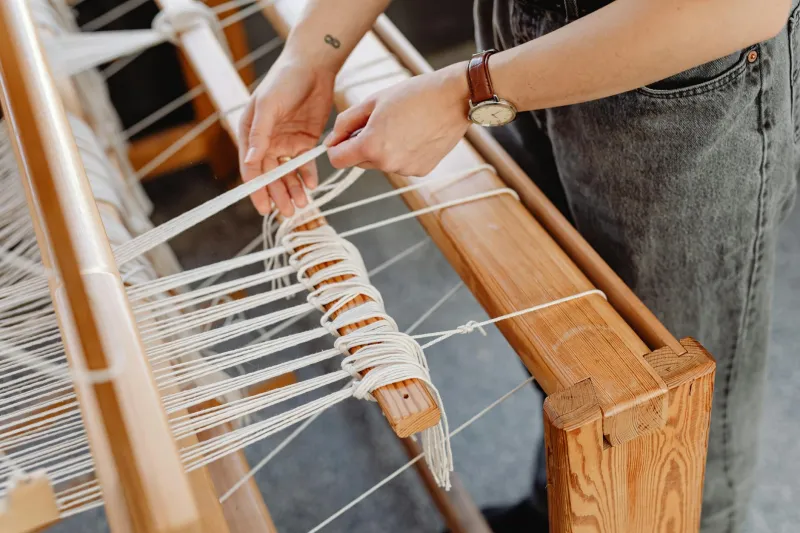
The clack-thump of Donald John MacKay's loom echoes across the croft like a heartbeat made audible. In his stone cottage on the Isle of Harris, where Atlantic gales rattle the windows and sheep graze on machair grass, he works the same Hattersley loom his father used, and his grandfather before that. Each throw of the shuttle carries forward a tradition that has never broken, never paused, never surrendered to the machinery that transformed textile production elsewhere.
 Photo: Isle of Harris, via images.squarespace-cdn.com
"This isn't nostalgia," MacKay says, his hands moving with unconscious precision across the warp threads. "This is how cloth should be made — by someone who knows the wool, knows the weather, knows what the finished fabric needs to do."
Across Britain, in workshops tucked into valleys and hidden behind high street shops, the last generation of hand-loom weavers maintains techniques that predate the Industrial Revolution. They work not as museum pieces or heritage performers, but as living practitioners of crafts that shaped British culture for millennia. Their looms produce textiles that carry something no factory can replicate — the accumulated wisdom of place, climate, and human skill.
The Geography of Thread
Every weaving tradition reflects its landscape. In the Outer Hebrides, where Harris Tweed still carries legal protection, the cloth emerges from an environment of wind, rain, and resilient sheep. The wool is scoured in the soft water of island streams, dyed with local plants — crottle lichen for deep reds, bog myrtle for yellow, elder bark for black — and woven on looms that have adapted to the rhythm of island life.
"The tweed tells the story of where it comes from," explains Mary MacDonald, whose family has woven Harris Tweed for four generations. "You can see the colours of the moorland, feel the strength that comes from sheep that graze on sea-sprayed grass. Industrial cloth might look similar, but it doesn't carry the same knowledge."
In Macclesfield, where the Silk Road once ended in terraced streets lined with throwing mills, a different tradition persists. Here, in workshops that once hummed with power looms, hand-weavers work with silk threads so fine they seem to capture light itself. The techniques, brought by Huguenot refugees in the 18th century, created fabrics for royal courts and fashionable drawing rooms.
The Rhythm of the Loom
Jenny Gorrod learned to weave silk in one of Macclesfield's last working hand-loom shops, where her teacher had learned from women who remembered the town's golden age. "Silk weaving isn't like working with wool," she explains, adjusting the tension on threads that shimmer like captured moonlight. "The fibres are so delicate, so responsive to moisture and temperature. You have to develop a feel for it — know when the air is too dry, when your hands are moving too quickly, when the thread is ready to break."
The knowledge required goes far beyond operating machinery. Traditional weavers understand the behaviour of different fibres, how wool from hill sheep differs from lowland fleeces, why silk from certain cocoons produces stronger thread, how plant dyes interact with different textile bases. They read weather patterns, knowing that humidity affects thread tension, that barometric pressure changes how fibres behave.
In the Yorkshire Dales, where woollen mills once lined every beck and stream, Tom Harrison works a floor loom in a converted barn, producing the kind of heavyweight cloth that clothed working people for generations. His tweeds and worsteds carry the character of Pennine wool — strong, weather-resistant, built to last.
"People don't understand what we lost when the mills closed," Harrison says. "Not just jobs, but knowledge. Ways of working with wool that took centuries to develop. I'm trying to keep some of that alive, but it's hard work learning what used to be common knowledge."
The Apprentice Weavers
Across Britain, a new generation is discovering the satisfaction of creating cloth by hand. They come from different backgrounds — former textile designers seeking more authentic expression, craft enthusiasts drawn to traditional techniques, young people looking for work that connects them to something larger than themselves.
In a workshop in the Cotswolds, where wool merchants once grew wealthy on the backs of sheep, Sarah Bennett teaches traditional weaving techniques to students from around the world. Her looms — some dating back to the 19th century — produce fabrics that high-end fashion designers prize for their unique character.
"Hand-weaving creates irregularities that machines can't replicate," Bennett explains. "Slight variations in tension, tiny differences in thread thickness — these aren't flaws, they're what gives hand-woven cloth its life, its personality."
Her students learn not just technique but the deeper knowledge that surrounds traditional weaving — how to read wool quality, understand different breeds of sheep, work with natural dyes, adapt patterns to suit specific purposes. They discover that weaving is as much about understanding materials as operating looms.
Patterns in Time
Traditional British weaving carries encoded information — patterns that reveal regional preferences, social status, intended use. The complex geometries of Highland tartans, the subtle checks of Border tweeds, the intricate damasks of ceremonial cloth — each represents generations of accumulated aesthetic and technical knowledge.
"Every pattern has a history," says Margaret Stewart, who weaves traditional Scottish textiles in a workshop overlooking Loch Katrine. "Some were designed for specific clans, others for particular trades. The patterns weren't just decorative — they were functional, helping cloth behave in certain ways, creating visual effects that served practical purposes."
 Photo: Loch Katrine, via images.freeimages.com
Stewart works from pattern books that date back to the 18th century, but she also develops new designs based on traditional principles. Her work demonstrates that traditional techniques needn't be frozen in time — they can evolve while maintaining their essential character.
The Future of the Loom
The survival of hand-loom weaving depends partly on finding markets for textiles that cost more and take longer to produce than industrial alternatives. But it also requires preserving the knowledge itself — the accumulated understanding of how different fibres behave, how traditional patterns achieve their effects, how regional variations in technique produced distinctive local styles.
Some weavers are documenting their techniques, creating video records of complex processes that were traditionally passed down through apprenticeship. Others focus on teaching, ensuring that knowledge accumulated over generations doesn't disappear with its current practitioners.
"We're not trying to turn back the clock," says David MacLeod, who weaves Harris Tweed in a workshop that overlooks the Sound of Taransay. "But we are trying to preserve something valuable — the knowledge of how to create beautiful, durable cloth using techniques that connect us to our ancestors and our landscape."
In workshops across Britain, the rhythm of hand-operated looms continues — not as a heritage performance, but as a living tradition that produces textiles carrying the memory of place in every thread. These weavers work at the intersection of past and present, maintaining techniques that shaped British culture while adapting them for contemporary needs.
Their looms may be old, but their work is thoroughly modern — creating textiles that offer an alternative to mass production, carrying forward knowledge that took centuries to accumulate, proving that some things are too valuable to be left entirely to machines.