Jar by Jar: The Home Fermenters Keeping Britain's Larder Wisdom Alive
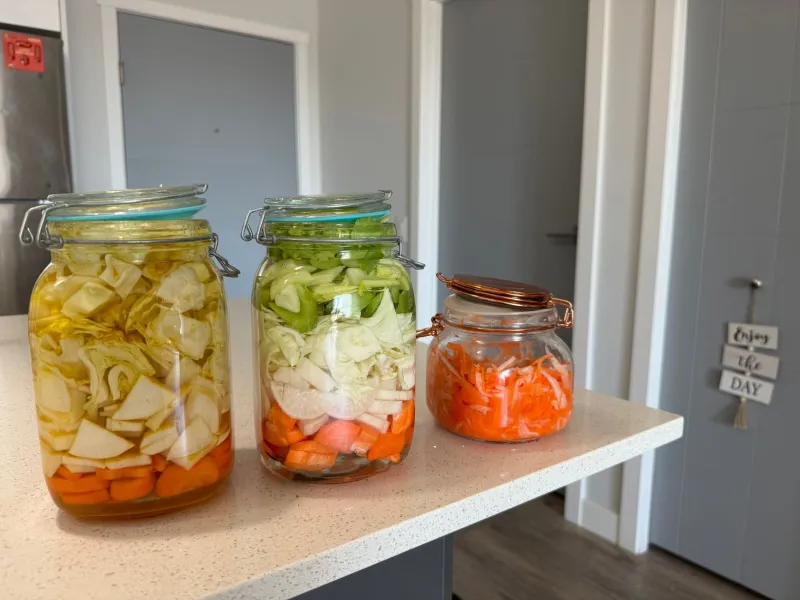
Sarah Donoghue's kitchen smells of time. Not in an unpleasant way — more like the inside of a good cellar, or the back room of a proper farm shop. There are crocks on the counter, kilner jars lined up on a shelf by the window, a cloth-covered bowl sitting near the radiator doing something slow and purposeful. A culture of water kefir grains she's been feeding since 2019 lives in a jar next to the kettle, which she refers to, without apparent embarrassment, as "the grains."
"My gran had this," she says, gesturing at the general organised clutter of ferments in progress. "Not these exact things — she did mostly pickles, chutneys, bottled fruit. But the principle was the same. You didn't waste. You made things last. You kept the harvest going through winter by transforming it into something else."
Sarah lives in a terraced house in Hebden Bridge, works part-time in a library, and is part of a loosely connected network of home fermenters that has grown steadily across West Yorkshire over the past six years. They meet occasionally in village halls and each other's kitchens, share cultures and starter packs, swap recipes and troubleshooting advice, and post updates in a group chat that runs to hundreds of messages a week.
The Long Tradition Behind the Trend
Fermentation has attracted its share of lifestyle coverage in recent years — the kombucha cafés, the artisan kimchi start-ups, the glossy books with minimalist covers. But the people doing it at home, seriously and continuously, are often motivated by something that sits outside trend cycles entirely.
For many of them, it's explicitly about recovery. Recovery of skills that slipped away over two or three generations when refrigeration, supermarkets, and industrial food processing made preservation seem unnecessary. Britain had its own rich fermentation heritage long before Korean or Eastern European traditions arrived here — Suffolk bang cheese, potted meats, hedgerow vinegars, brine-cured vegetables, real ale and cider traditions that are themselves forms of fermentation. Much of it was simply forgotten because it became inconvenient.
"There's a kind of amnesia in British food culture," says Priya Nair, a fermentation educator based in Bristol who runs workshops out of a community kitchen in Easton. "We exported our own traditions, then reimported them from other cultures and called them fashionable. But the underlying knowledge — how to use salt, time, and microbes to preserve and transform food — that's not exotic. It's ancient. It's ours too."
Priya's workshops draw a mixed crowd: young renters trying to cut food waste, older participants reconnecting with things their parents once did without thinking, first-generation immigrants who never lost the knowledge and are now finding a community that values it. The sessions are deliberately non-prescriptive. She teaches principles rather than rigid recipes, because that's how this knowledge originally worked — passed between people who adapted it to what they had.
Crocks and Community
What's striking about the fermentation revival is how communal it tends to be. Cultures can't be owned — they're living things that get divided and shared. A sourdough starter passed from baker to baker carries a kind of lineage. Kefir grains multiply and need to be given away. Kombucha SCOBYs reproduce whether you want them to or not. The biology of fermentation is inherently generous.
In Edinburgh, a community fermentation library has been running from a converted shop unit in Leith for three years. Members can borrow cultures, return them divided, and access a reference collection of preservation manuals and recipe books going back to the nineteenth century. The library was started by two friends who wanted somewhere to keep the knowledge organised, and it's grown into something that serves well over two hundred regular participants.
"The old cookbooks are extraordinary," says co-founder Alistair Garvie. "There are instructions in Victorian household manuals for fermenting things we've completely stopped eating — fermented oatmeal drinks, soured grain porridges, pickled walnuts in brine with spices. Some of it sounds strange now, but it all made sense in a world where you couldn't just pop to a shop."
The library also collects oral histories — recorded conversations with older members of the community who remember watching their grandmothers make things that have no written recipe anywhere. These recordings are archived alongside the books, treating kitchen memory as legitimate cultural heritage.
Resistance and Ritual
For some practitioners, home fermentation is explicitly political. In a food system dominated by a handful of massive retailers and increasingly consolidated supply chains, the ability to transform raw ingredients into preserved food at home represents a form of autonomy that feels increasingly countercultural.
"I'm not naive enough to think my jar of sauerkraut is going to bring down Tesco," says Sarah with a grin. "But it does mean I'm not entirely dependent on the system. There's something about having food on your shelves that you made yourself, that will keep for months, that feels like a small act of self-determination."
Others talk about it in terms that are harder to categorise — something closer to the spiritual. The rhythms of fermentation, the attention required to maintain a culture, the patience of watching something transform over days and weeks — these create a relationship with food that has largely disappeared from modern life.
"You start to understand that food isn't static," says Priya. "It's alive. It's in process. The same ingredients become different things depending on time, temperature, the bacteria in your particular kitchen. There's real humility in that. You're not in control. You're collaborating."
The Knowledge That Keeps
What all these practitioners share is a sense that what they're doing matters beyond the contents of the jar. They're maintaining a thread of knowledge that, once broken, is very difficult to reconstruct. Not impossible — the books exist, the techniques can be relearned — but the living transmission, the knowing in your hands, the instinct that tells you when a ferment is ready, that comes only from doing it repeatedly over time.
Sarah's gran is in her nineties now and still talks about the chutneys and pickles she made in a farmhouse kitchen in County Clare before she came to England. Sarah takes notes when she visits. She's making sure the thread doesn't break on her watch.
"She never called it a tradition," Sarah says. "She just called it getting through winter. But that's what traditions are, aren't they? Practical knowledge that survived because it was worth keeping."