Feet First: The Pub Back Rooms Where Britain Relearned to Dance on the Spot
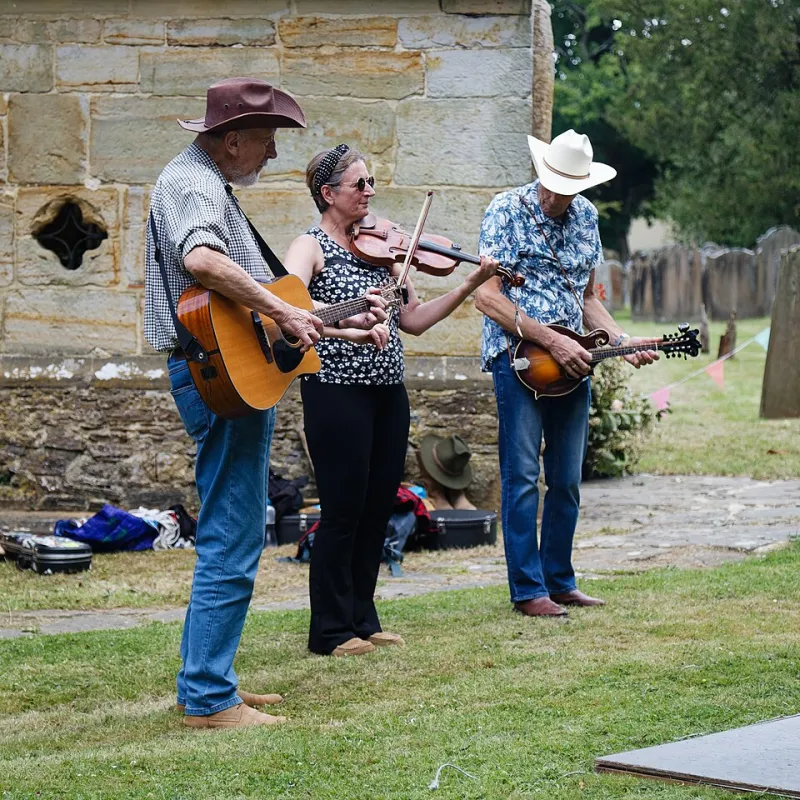
Photo: Acabashi, CC BY-SA 4.0, via Wikimedia Commons
The Back Room Where Nobody Watches
There's a room behind the bar of the Old Crown in Wirksworth that used to be a dairy store. On Tuesday nights it fills with about twenty people, a wooden platform made from reclaimed scaffolding boards, and a fiddle player who never asks anyone to stop talking. Nobody performs here. That's the point.
Step dance — the business of making rhythm with your feet while staying roughly in one place — is having a quiet resurgence, and it's happening not on stages but in rooms like this one, from Derbyshire to Northumberland. The revival's engine isn't television or TikTok. It's the village hall workshop, the folk festival late session, and the slow realisation that you don't need a stage, a costume or even a partner to join in. You need soles. Preferably wooden ones.
Two Oceans, One Shuffle
The most surprising thing for newcomers is how many cousins this dance has. North-west clog, the morris-adjacent step tradition of Lancashire and Cheshire, grew out of mill towns and rush-bearing processions. Meanwhile, across the Atlantic, Appalachian flatfooting evolved from the same British and Irish immigrant steps, cross-pollinated with African American percussive dance, and came home.
And when the cousins meet — which they now do, regularly, at festivals like Sidmouth, Bromyard and Whitby — the steps turn out to be astonishingly compatible. A basic clog shuffle and a basic flatfoot step are separated by a couple of generations and an ocean, not a canyon.
"I learned from a DVD of Thomas Maupin," says Karen, a retired nurse who's been coming to the Wirksworth night for two years. "Then I found out the woman three seats down had learned the same figure from her gran in Ashton-under-Lyne. Same rhythm. Different words for it. We argue about what to call it and dance it identically."
First Shuffle Nerves
The session runs on a simple structure: mixed ability, no pressure, a caller who demonstrates everything twice and then gets out of the way. Beginners cluster near the door with their arms slightly out like people stepping onto ice. Within twenty minutes, the room settles into a shared pulse — fiddle, banjo, and the low thud of feet finding a pattern.
The teaching philosophy is anti-spectacle. There's no mirror, no rank ordering, no 'front'. The platform is big enough for six; the rest dance on the flagstones, which have been absorbing footsteps since the 1700s and don't seem to mind.
What strikes you is the ordinariness of it. Step dance was always workers' dance — done in clogs because clogs were what you had, done in kitchens and yards because that's where you were. The revival hasn't romanticised that so much as picked it back up. You can arrive exhausted from work and leave having made music with your own body, which is a difficult thing to put a price on.
The Rapper Sword Detour
Twice a month, the night is invaded by a Northumberland rapper sword team passing through — five dancers linked by flexible swords, weaving in and out of locks at a pace that seems designed to alarm health and safety officers. Rapper isn't step dance, strictly, but the two traditions have shared pubs, dancers and festival billings for a century, and the cross-pollination is real: several of the cloggers here started out as rapper dancers who wanted something to do with their feet while resting their arms.
"Rapper teaches you to listen," one of the team tells me between figures. "Step dance teaches you to breathe. Do both and you'll never be bored at a folk festival again."
Last Set
By ten o'clock, the room has sorted itself into that warm, slightly sweaty equilibrium that only village pub traditions produce. The last tune is a slow hornpipe, and even the woman who arrived swearing she had two left feet is shuffling, tentatively, with her hands on the bench behind her.
Nobody films it. Nobody needs to. The steps go home in people's bodies, and next Tuesday some of them will come back carrying new ones, picked up from a festival field or a YouTube video or a grandmother. The tradition doesn't live in an archive. It lives in the back room, one shuffle at a time.