Colour From the Commonplace: The Dyers Reading Britain's Hedgerows as Living Archives
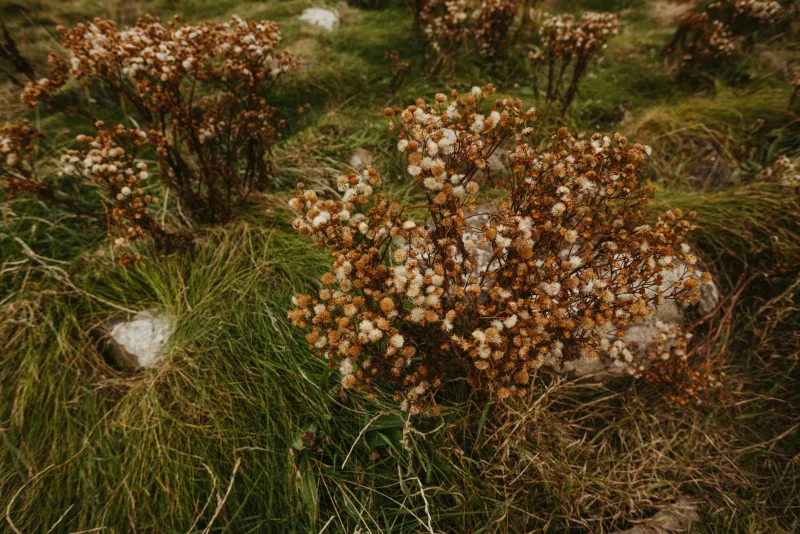
There's a jar of something dark and brackish sitting on a windowsill in a converted outbuilding near Stroud, and Naomi Cleaver wants you to know it took her three years to get right. The liquid inside is a weld extract — weld being Reseda luteola, a tall, unremarkable plant that colonises roadsides and disturbed ground across lowland Britain and has been producing one of the most stable yellow dyes known to textile history since at least the Bronze Age. The jar doesn't look like much. The cloth she's dyed with it, hanging in loose skeins from a wooden rack nearby, is a deep, warm gold that seems to hold the light rather than simply reflect it.
"Synthetic yellow is flat," Naomi says, holding a skein up to the window. "It's the same everywhere. This changes depending on the mordant, the water hardness, how long you leave it. It's alive, basically. It has variation. That's what makes it interesting."
Naomi is one of a loosely connected community of botanical dyers working across Britain — from Orkney to Cornwall, from the Welsh borders to the Norfolk Broads — who are treating the country's plant knowledge not as a historical curiosity but as active cultural inheritance. They forage, they grow, they collaborate with farmers and conservationists. And increasingly, they're teaching.
What Got Lost in the Dye Vat
Before the development of synthetic aniline dyes in the mid-nineteenth century, every colour in British textiles came from plant, animal or mineral sources. The knowledge of which plants produced which colours, how to fix them to fibre, how to modify and layer them — this was regional, practical, and passed through families and guilds in the same way that any craft knowledge was transmitted. Woad from East Anglian fields for blue. Weld for yellow. Weld and woad together for a particular kind of green. Madder — grown commercially in Kent and Lincolnshire — for reds and oranges. Oak galls, alder bark, walnut husks, elderberries, onion skins: the palette was everywhere, once you knew where to look.
The arrival of cheap, consistent, industrially produced dyes effectively severed this knowledge from practice within two generations. What survived did so in fragments — in herbals, in regional craft manuals, in the memories of older weavers and dyers who were rarely asked to record what they knew. By the late twentieth century, botanical dyeing had become largely the preserve of hobbyists and craft revivalists, disconnected from any commercial supply chain and treated, at best, as charming anachronism.
"The knowledge didn't disappear completely," says Dr Fiona Mackintosh, a textile historian at the University of Edinburgh who has been documenting Scottish plant-dye traditions for the past decade. "But it became atomised. People held pieces of it without knowing what the wider picture looked like. Part of what's happening now is that people are putting the pieces back together."
The Recipe as Inheritance
For many botanical dyers, historical recipes are the starting point — but only the starting point. Naomi has spent years working through documented recipes from sources as varied as eighteenth-century Scottish estate records, Victorian craft manuals, and the notebooks of individual weavers held in local archive collections. The recipes are often incomplete, written for an audience that was assumed to already know the basics, and they frequently use plant names that have shifted meaning over the centuries.
"Half the work is just figuring out what plant they're actually talking about," she says. "And then you have to work out what they mean by 'a sufficient quantity' or 'the right heat.' Those are the things that were never written down because everyone knew them. That's the knowledge that's really gone."
Recovering it requires a combination of archival research, collaboration with botanists and ecologists, and a great deal of experimental work — trying things, observing what happens, adjusting, trying again. It's slow, iterative, and occasionally maddening. It's also, Naomi insists, the point.
"If you just buy a recipe and follow it exactly, you're not really learning anything. You're just executing instructions. The knowledge lives in understanding why each step matters. That's what I try to teach."
Growing the Supply Chain
One of the practical challenges facing botanical dyers who want to work at anything beyond a small personal scale is sourcing. Wild-harvesting is limited by ecology and legality — most plants are protected to some degree on land you don't own, and sustainable harvesting requires knowledge and restraint. Growing your own works for some species but requires land, time, and agricultural knowledge that not everyone has.
Several dyers are addressing this by building direct relationships with farmers and smallholders. In Lincolnshire, a small collective of dyers has partnered with an organic arable farm to trial the commercial cultivation of weld and woad on field margins — plants that historically thrived in exactly these conditions and which, as it turns out, are reasonably compatible with low-input farming systems. In the Scottish Borders, a weaving cooperative sources alder bark as a by-product from a woodland management operation, turning what would otherwise be waste material into a consistent, locally rooted dye supply.
"The supply chain is the whole thing," says textile maker and dyer Priya Sharma, who works from a studio in the West Midlands and sources the majority of her plant materials from within a fifty-mile radius. "If the plants aren't grown here, by people I know, on land I understand, then I'm not really making a local product. I'm just making a product with local marketing."
Priya is also one of a growing number of botanical dyers who have moved into fashion — producing small runs of naturally dyed cloth for independent clothing makers, selling directly to consumers who want to know the full provenance of what they wear. The market is niche but growing, driven in part by a broader shift in consumer attitudes towards transparency and sustainability, and in part by a genuine aesthetic appeal that synthetic dyes simply can't replicate.
Passing It On
Mentorship and teaching have become central to how this community sustains itself. Workshops — ranging from half-day introductions to week-long intensives — run throughout the year at studios, farm venues, and craft centres across the country. Some dyers have developed structured apprenticeship-style arrangements, taking on one or two learners at a time for extended periods of practical work.
"I'm not interested in teaching people to make pretty things," Naomi says, with a frankness that's characteristic. "I'm interested in teaching people to understand the plant, understand the fibre, understand the chemistry — even if it's intuitive rather than scientific — and to make decisions based on that understanding. That's the knowledge I want to pass on."
For Dr Mackintosh, what's happening in studios like Naomi's is something worth paying close attention to, even from an academic perspective. "There's a kind of knowledge production happening here that doesn't go through universities or journals," she says. "It's practical, it's embodied, it's transmitted person to person. That's how most knowledge has always moved. We just stopped noticing for a while."
The Colour of Somewhere Specific
On a shelf in Naomi's studio, a row of small sample cards shows the results of years of experimentation: the pale gold of young birch leaves, the deep rust of walnut, the soft grey-green of lichen (used sparingly, given how slowly it grows), the warm brown of oak gall. Each card is labelled with the plant, the mordant, the water source, the date.
Taken together, they look like a map. Not of geography exactly, but of a particular relationship between a person, a landscape, and a long tradition of noticing what the land can offer. That relationship is what botanical dyeing, at its best, is actually about.
"Every colour on that shelf is from somewhere specific," Naomi says. "That weld came from a roadside cutting near Fairford. That walnut came from a tree in my neighbour's garden. The colour isn't just a colour. It's a place, and a time, and a decision someone made about what knowledge was worth keeping."
In a world drowning in identical synthetic hues, that kind of specificity feels quietly radical.