Gap by Gap: The Apprentices Rebuilding Scotland's Stone Boundaries From the Ground Up
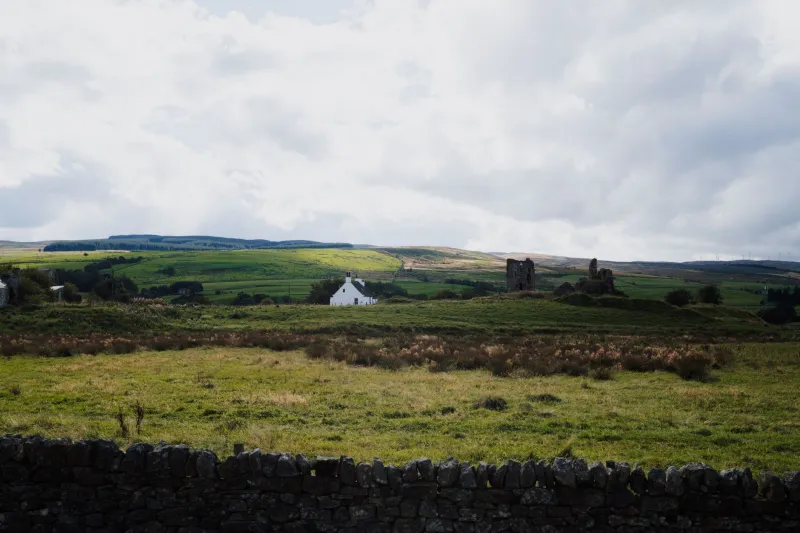
It's barely eight in the morning on a Perthshire hillside and Morag Strachan is already on her knees. Not in prayer, though there's something devotional about the way she lifts each stone — turning it, weighing it in her hands, setting it down again if it doesn't speak to her. She's been building dry-stone dykes for twenty-three years. Her apprentice, Jamie Callander, twenty-one years old and two months into his placement, stands a few feet back and watches.
"Don't just grab," Morag tells him, not unkindly. "Look first. The stone knows where it wants to go."
It sounds like mysticism. It isn't. It's pattern recognition earned across thousands of hours, a kind of physical literacy that no textbook fully captures. And it's exactly the kind of knowledge that, until recently, was quietly disappearing from Scotland's countryside.
What a Collapsing Wall Actually Means
Scotland has somewhere in the region of 140,000 kilometres of dry-stone dyke. That figure sounds impressive until you consider how much of it is in a state of serious disrepair. Surveys carried out by the Dry Stone Walling Association of Great Britain (DSWA) have consistently shown that large stretches across Dumfries and Galloway, the Borders, and the Highland fringes are either partially collapsed or structurally compromised. The causes are multiple — livestock pressure, frost heave, decades of agricultural change, and above all, a shortage of people who know how to fix them.
These aren't just picturesque features. Dry-stone dykes are working infrastructure. They manage livestock, define ownership, channel water, and shelter both animals and the extraordinary communities of mosses, lichens, and invertebrates that colonise their crevices. When a dyke falls, it takes an entire ecosystem — and a piece of cultural geography — with it.
"People think it's just stacking rocks," says Alasdair MacPherson, regional coordinator for the DSWA in Scotland. "But a well-built dyke is an engineering achievement. The throughstones, the hearting, the cope — every element has a function. Get it wrong and it comes down in ten years. Get it right and it stands for two hundred."
Learning the Language of the Moor
The apprenticeship scheme that brought Jamie to Morag's hillside is relatively new in its formalised state, though the knowledge it transmits is ancient. Run in partnership between the DSWA, Scottish Natural Heritage, and several rural colleges, it matches trainees with experienced dykers for a structured season of work that covers everything from basic coursing to complex corner-building and gateway construction.
What the scheme can't fully replicate — and what Morag is quietly anxious about — is the accumulated local knowledge that used to pass down through families and farming communities. Different regions of Scotland developed distinct dyking traditions. Galloway dykes, with their characteristic double-wall construction and open hearting, look nothing like the tighter, darker-stoned dykes of Caithness. The limestone country of the Borders produces walls of a completely different character to the schist and granite of the far north.
"My grandfather built dykes on this same farm," Morag says, gesturing across the valley. "He could look at a stretch of wall and tell you roughly when it was built and who likely built it. That's gone now, mostly. We're trying to get some of it back."
Jamie, for his part, is an unlikely recruit to the trade. He studied geography at university, dropped out after a year, spent six months feeling lost, and stumbled across a DSWA demonstration day at an agricultural show in Stirling. Something clicked.
"I'd never really worked with my hands before," he admits. "But the first time I built a section that actually stood up properly, I felt something I hadn't felt in a long time. Like I'd actually made something real."
The Geometry of Patience
Watching Morag and Jamie work together over the course of a morning is a study in contrasts. She moves with an unhurried certainty, each placement deliberate and final. He moves faster but second-guesses himself more, picking up a stone and putting it back three times before committing. She doesn't correct him constantly — she lets him feel the consequences of a poor choice before intervening.
"If I tell him every time, he'll just wait for me to tell him," she explains during a tea break. "He needs to learn to feel when something's wrong before the wall tells him."
The technical vocabulary of the trade is itself a kind of inheritance. Throughstones — the long stones that bind the two faces of a wall together — are sometimes called throughs or tie-stones depending on where you are. The hearting, the rubble packed into the wall's core, has to be placed, not poured. The cope, the capping stones that sit on top, needs to be set at an angle to shed water. Every term carries centuries of practical reasoning inside it.
By mid-afternoon they've rebuilt roughly four metres of collapsed boundary — a modest total that would frustrate anyone expecting visible progress. But the rebuilt section is solid, the faces flush, the cope tight. In two hundred years, if the land is still farmed, someone may rebuild it again. They won't know who built it this time. But the work will still be speaking.
Certification, Competition and Community
The DSWA runs a formal certification system with five levels, from novice to master craftsman. Competitions — including the annual championships held at agricultural shows across the UK — draw wallers from Scotland, Northern England, Ireland, and beyond, and have become important gatherings for a community that is otherwise scattered thinly across remote landscapes.
For younger apprentices, the competitions serve a crucial social function. They meet peers, compare techniques, swap knowledge about regional stone types and traditions. For many, it's the first time they've encountered a genuine community of practice around something they'd begun to think of as a solitary pursuit.
"The competitions are brilliant for confidence," says Alasdair MacPherson. "But more than that, they're how the tradition talks to itself. People bring methods from their own regions and you see them influence each other. The tradition is still evolving."
The Wall That Keeps Building
As the light drops on the Perthshire hillside, Morag and Jamie pack their tools and stand back to look at what they've done. The repaired section blends into the old wall on either side — not perfectly, not yet, but convincingly. Jamie runs his hand along the cope stones, checking for movement.
"Good," Morag says. That's all. But from her, it clearly means something.
The apprenticeship has another eight months to run. By the end of it, Jamie will have rebuilt portions of dyke across three different Scottish landscapes, encountered perhaps a dozen distinct local stone types, and begun to develop the physical intuition that separates a competent waller from a genuinely skilled one. He won't be Morag yet. He'll be himself — a new link in a very long chain.
That chain, fragile as it sometimes seems, is what these programmes are fighting to maintain. Not as nostalgia. Not as heritage tourism. But as a living, necessary skill, embedded in a landscape that still needs it.
The stones aren't going anywhere. Neither, it turns out, are the people who know how to read them.