Cut, Split, Trust: What a Notched Hazel Stick Can Still Teach Us About Honest Exchange
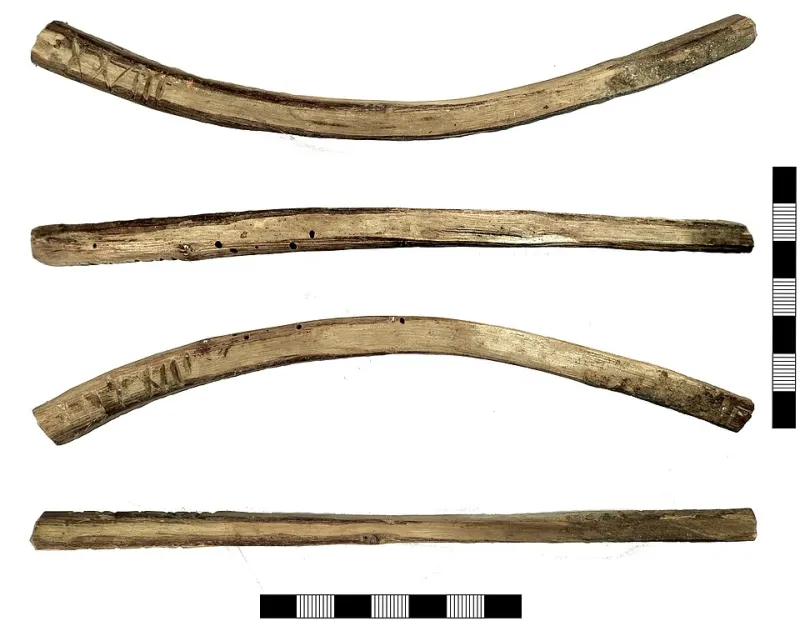
Photo: Surrey County Council, Simon Maslin, 2019-07-03 13:48:27, CC BY 2.0, via Wikimedia Commons
Let's start with something that sounds like a riddle. How do you create a record of a transaction that both parties can verify independently, that cannot be altered by either side without the other knowing, and that requires no third party, no institution, and no literacy to operate? The answer, for most of British history, was a piece of hazel wood and a sharp knife.
The tally stick is one of those objects that makes you reconsider everything you thought you knew about the sophistication of pre-modern life. It is, in its essentials, breathtakingly simple: a notched stick, split lengthways, with one half — the stock — kept by the creditor and the other — the foil — held by the debtor. The notches record the amount owed. The split ensures that neither party can falsify the record without the fraud being immediately obvious when the two halves are rejoined. It is tamper-evident, distributed, and requires no intermediary to validate it.
This was not a primitive workaround. This was a technology.
The Stick That Outlasted the Press
The English Exchequer used wooden tally sticks as its primary financial instrument from at least the twelfth century until 1826 — a span of time that comfortably brackets the entire history of the printing press, the industrial revolution, and the birth of the modern banking system. When the Exchequer finally abandoned them in favour of paper records, it stored the accumulated centuries of sticks in the cellars of the Houses of Parliament. In 1834, someone decided to burn them. The resulting fire got out of hand and destroyed most of the old Palace of Westminster. The new Houses of Parliament — the ones that stand today, with their Gothic towers and their tourist queues — are, in a roundabout way, the tally stick's monument.
 Photo: Palace of Westminster, via cdn-imgix.headout.com
 Photo: Houses of Parliament, via static.vecteezy.com
It's a story that feels almost too apt: the old system, literally fuelling the new architecture of power.
Beyond the Exchequer, tally sticks were used at every level of British economic life. Farmers recorded grain debts with them. Millers tracked customers' accounts. Alehouses kept running totals of what regulars owed. The word "stock" — as in livestock, or the stock exchange — derives directly from the creditor's half of the tally. The language of modern finance is, quietly, the language of notched wood.
Hands That Know the System
Martin Carey makes tally sticks in a workshop in rural Herefordshire. He came to them through his work as a green woodworker — he makes chairs, tool handles, and baskets from locally coppiced hazel and ash — and became fascinated by the tally after a conversation with a museum curator about medieval rural accounting.
 Photo: Martin Carey, via pyxis.nymag.com
"The first thing that strikes you when you actually make one is how satisfying it is," he says, drawing a blade along a length of hazel to demonstrate the split. "There's an elegance to it. The information is in the wood. You can feel the notches. You can match the halves in the dark."
Carey now runs occasional workshops on tally-making, drawing participants from a range of backgrounds — woodworkers, obviously, but also people involved in local exchange schemes, time-banking networks, and community currency projects. The interest, he says, is rarely purely historical.
"People come because they're thinking about trust. About how you record an obligation between people who know each other, without having to involve a bank or a platform or some algorithm that takes a cut. The tally is a genuinely elegant answer to that problem. It's been a genuinely elegant answer for about four thousand years."
The Trust Problem
There's a reason tally sticks keep appearing in conversations about alternative economics and community exchange, and it goes beyond nostalgia for pre-industrial simplicity. The stick's fundamental design encodes something that digital systems struggle to replicate: mutual vulnerability.
When you split a tally, both parties hold an incomplete record. Neither the stock nor the foil means anything in isolation. The transaction only becomes legible — only becomes real, in a sense — when the two halves are brought together. This is not a metaphor. It is the actual mechanics of the system. And it creates a relationship between creditor and debtor that is physically, materially reciprocal.
Dr Frances Mould, who researches community economics at a research institute in Bristol, has been thinking about this dimension of tally culture for several years. "Digital ledgers are very good at recording transactions," she says carefully. "What they're less good at is encoding the relational quality of exchange. The tally stick is, in a literal sense, a shared object. The record belongs to both parties equally. That's quite a different starting point."
She's careful not to romanticise pre-modern economic life, which was frequently brutal and exploitative. But she argues that the tally's design logic — transparent, bilateral, physically embodied — offers a useful provocation for communities thinking about how to build local exchange systems that feel genuinely reciprocal rather than transactional.
Revival in the Margins
A handful of community groups across Britain have begun experimenting with tally-inspired record-keeping, usually within time-banking or skills-exchange contexts. The tallies being used aren't always wooden — some are card-based, some digital tokens designed on tally principles — but the groups that work with actual notched sticks consistently report the same thing: the physical object changes the quality of the exchange.
"When you hand someone half of a stick," says Carey, "you're doing something different from sending them a text or logging a transaction on an app. You're giving them something. They're holding the same wood you're holding. There's a weight to it."
The folk historian and writer Tom Blackwood, whose recent work has explored material culture and community memory in post-industrial northern England, sees the tally revival as part of a broader pattern. "Across craft communities, across folk music, across all these living traditions, you see people reaching for things that have physical presence and social legibility," he says. "The tally stick fits that perfectly. It's not complicated. Everyone can understand it immediately. And it encodes values — honesty, mutuality, transparency — that people are hungry for right now."
There's something quietly radical about that hunger. In an age of opaque algorithms and platform economics that extract value from every human interaction, the image of two people each pocketing half of a notched hazel stick and trusting the wood to hold the truth between them is, depending on your mood, either charmingly archaic or quietly revolutionary.
Perhaps, as is so often the case with the oldest British traditions, it is both at once.