The Winders: Britain's Unsung Clockkeepers and the Towers They Never Leave Behind
The Winders: Britain's Unsung Clockkeepers and the Towers They Never Leave Behind
The stairs are always the first thing people mention. Narrow, worn smooth by generations of the same ascent, sometimes barely more than a ladder bolted to a stone wall. You go up with an oil can and a torch and a notebook, and the tower closes around you, and by the time you reach the clock room you're in a different century entirely.
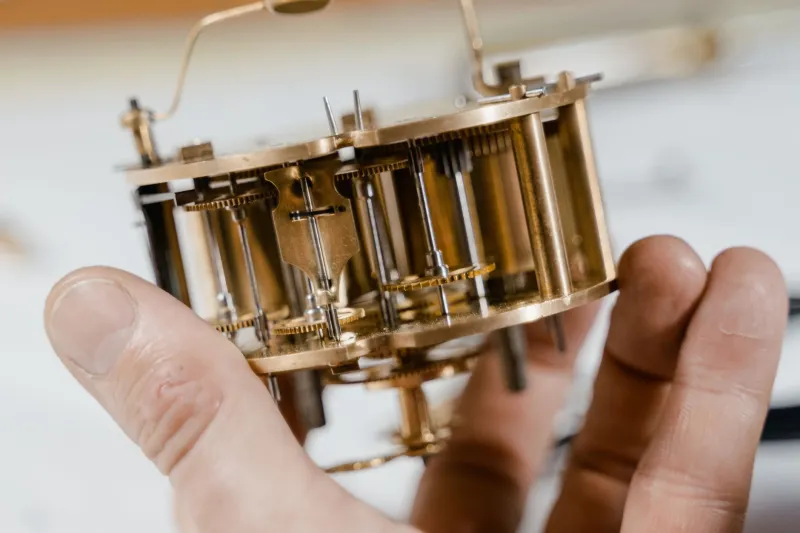
The clock itself — massive, angular, smelling of old metal and older oil — doesn't care what year it is outside. It cares about the tension in its springs, the cleanliness of its pivots, the precise calibration of its escapement. It has been telling the same community the same time, more or less reliably, for anywhere between a hundred and four hundred years. And somewhere in Britain right now, someone is climbing those stairs to make sure it keeps doing so.
Keeping the Nation's Time, One Tower at a Time
Britain has somewhere in the region of 10,000 turret clocks — the technical term for the mechanisms installed in church towers, market halls, and civic buildings — ranging from Victorian cast-iron workhorses to medieval movements of breathtaking complexity. The majority are maintained not by professional clockmakers but by volunteers: retired engineers, enthusiastic amateurs, and the occasional hereditary clock-winder whose family has been climbing the same tower for three or four generations.
The British Horological Institute estimates that a significant proportion of these movements are in reasonable working order, which is remarkable given their age and the conditions they operate in — exposed to cold, damp, bird interference, and the vibrations of a bell tower in full swing. That they function at all is largely down to the dedication of people who have taught themselves the specifics of their particular clock, often from original manufacturer's drawings and the accumulated wisdom of whoever wound it before them.
 Photo: British Horological Institute, via www.joho.de
In a small market town in Shropshire, the same family has maintained the church clock for eighty-seven years. The current keeper, a retired teacher in her sixties, learned the job from her father, who learned it from his. She winds the clock twice a week, adjusts it for the seasons, and has a relationship with its particular quirks — a slight tendency to gain time in cold weather, a pivot that needs attention every eighteen months — that no manual could fully document.
"You learn the clock," she says, simply. "It's got a personality. They all have."
What These Clocks Actually Are
It's worth pausing on the mechanics, because the engineering of a turret clock is genuinely extraordinary and almost entirely invisible to the people whose days it has regulated.
The earliest surviving English turret clocks date from the fourteenth century, and while the technology has evolved considerably since then, the fundamental principle — a weighted or spring-driven gear train regulated by an escapement — has remained essentially unchanged. What varies enormously is the execution: the size, the materials, the type of escapement, the striking mechanism, the dial arrangement.
The great clockmaking firms of the eighteenth and nineteenth centuries — Dent, Thwaites & Reed, John Smith & Sons of Derby — left their movements in towers across the country, each with its own documentation, its own idiosyncrasies, its own requirements. Learning to maintain one is not the same as learning to maintain another, which is precisely why the local, inherited knowledge of volunteer clockkeepers is so irreplaceable.
Modern clock-care organisations like the Cumbria Clock Company and various regional horological societies have done valuable work in training new volunteers and creating networks of expertise. But the knowledge at the heart of it remains deeply personal: the feel of a correctly tensioned spring, the sound of an escapement running true, the subtle wrongness that tells you something needs attention before any measurement confirms it.
 Photo: Cumbria Clock Company, via cdni.coedcherry.com
The Meaning of Collective Time
There's a philosophical dimension to all of this that's easy to overlook when you're focused on the technical details. The parish clock was not simply a convenience. It was a technology of social cohesion — a shared reference point that allowed a community to coordinate its life without negotiation. When the clock struck noon, everyone knew it was noon. The same noon, for everyone, regardless of what any individual's domestic timepiece might claim.
The standardisation of time across Britain — driven by the railways in the 1840s, when the chaos of local solar time became operationally impossible to manage — is often told as a story of industrial modernity overwriting ancient local variation. And so it was. But the parish clock survived that standardisation and became, in a sense, its local face: the point at which national railway time met the specific stone tower of a specific community.
That relationship between shared public time and community identity is something we've almost entirely dismantled in the age of individual devices. Everyone carries their own clock now, perfectly accurate, perfectly synchronised, and perfectly private. Nobody looks up at the tower to know when the market opens or when the service starts. The clock still strikes, but we're no longer quite sure who it's striking for.
The Question of Succession
The most pressing practical concern for those who care about Britain's turret clocks is not mechanical — it's demographic. The volunteer clockkeepers who maintain the majority of these movements are, on average, getting older. The knowledge they carry is not easily transferable, and the pipeline of younger enthusiasts, while not empty, is narrower than anyone would like.
Several organisations are actively working on this. The Antiquarian Horological Society runs training days and mentorship schemes. Some cathedral clock teams have begun structured apprenticeship arrangements, pairing experienced winders with younger volunteers who will eventually take over. The British Horological Institute's education programmes have seen renewed interest in recent years, partly driven by a broader cultural appetite for analogue craft skills.
But there's something that training programmes can't fully replicate: the decades of relationship between a person and a specific clock in a specific tower. The accumulated knowledge of one particular movement, one particular set of quirks, one particular set of stairs. That knowledge lives in people, and when those people are gone, it doesn't automatically transfer.
Still Striking
On a clear night in a village with a working church clock, you can hear the quarters carry across the rooftops in a way that has been essentially unchanged since the movement was installed. The sound is particular — not like a recording, not like an app — because it's coming from a specific place, made by specific metal, regulated by a specific person's hands.
The clockkeepers who climb those stairs every few days aren't doing it for recognition. Most of them would be mildly embarrassed by the suggestion that what they do is remarkable. It's just the clock. It needs winding. Someone has to do it.
But in that quiet, practical devotion — the oil can, the notebook, the worn stone stairs — there's something that matters beyond horology. It's the maintenance of a shared relationship with time. The insistence that the community still has a clock, and that the clock still has someone who knows it.
When the tower falls silent, something more than the mechanism stops.