The Last Sheaf Stands: Britain's Corn Dolly Makers and the Spirit They Refuse to Let Go
The Last Sheaf Stands: Britain's Corn Dolly Makers and the Spirit They Refuse to Let Go
There's a moment, if you watch an experienced corn dolly maker at work, where the straw stops being agricultural waste and becomes something else entirely. The fingers move with a particular kind of quiet authority — tucking, folding, coaxing — and what emerges from the bundle isn't just a decorative object. It carries the weight of something much older than decoration.
For most of us, corn dollies are the slightly dusty things hanging in country pubs or sold at craft fairs alongside jam and beeswax candles. But spend any time with the people who actually make them, and you start to understand that the craft sits at a crossroads of agricultural history, pre-Christian belief, and an almost obsessive regional specificity that makes British folk traditions so endlessly fascinating.
When the Field Had a Soul
The practice begins, as so many British folk customs do, with a need to explain the world before science offered its own explanations. Across the agricultural communities of these islands, the harvest was understood to be inhabited — not metaphorically but literally — by a spirit that lived within the standing grain. As the reapers worked their way across a field, that spirit retreated ahead of the blades until, at last, it was concentrated in the final, uncut sheaf.
What you did with that sheaf mattered enormously. In some traditions it was plaited and twisted into a figure — a corn maiden, a neck, a kern baby — and brought into the farmhouse with ceremony, sometimes paraded through the village, sometimes hung above the hearth. The belief was that the spirit would winter there, kept safe in the plaited straw, ready to be returned to the first furrow in spring and so renew the fertility of the land.
The specific forms this took varied wildly from one county to the next, and that regional diversity is one of the things that makes the tradition so rich and so demanding to preserve.
A Geography Written in Straw
Ask Janet Summerfield, who has been making corn dollies in Suffolk for over thirty years, what distinguishes her county's form from those made two counties north, and she'll spend a happy half hour explaining it. "The Suffolk horseshoe has this particular curve to it," she says, smoothing a length of rye straw between her palms. "It's not just decorative. The shape itself has meaning — it was associated with protection, hung above stable doors. You can see why a farming community would want that."
The Cambridgeshire umbrella, with its spreading canopy of plaited straws, looks almost nothing like the horseshoe. The Staffordshire knot is all geometric tension. The Yorkshire spiral climbs like a compressed spring. The Welsh border fan spreads wide and flat. Travel north into Scotland and the forms shift again — the Bride's Cross, the cailleach, the last sheaf dressed as a woman and kept until Imbolc.
This isn't stylistic variation for its own sake. Each form evolved from specific agricultural conditions, local materials, and the particular ritual needs of that community. Wheat, rye, and oat straw all behave differently in the hand. The length of the internodes — the hollow sections between the joints — determines what shapes are even possible. Traditional makers worked with what grew in their fields, and the dollies they made reflected that intimacy with place.
The Worshipful Company of Farmers recognised the craft's importance by establishing a national collection of regional forms, and the Museum of English Rural Life in Reading holds examples that serve as reference points for contemporary makers. But the knowledge of how to make them — the precise sequence of folds, the tension required, the way to introduce new straws without breaking the rhythm — that lives in hands, not archives.
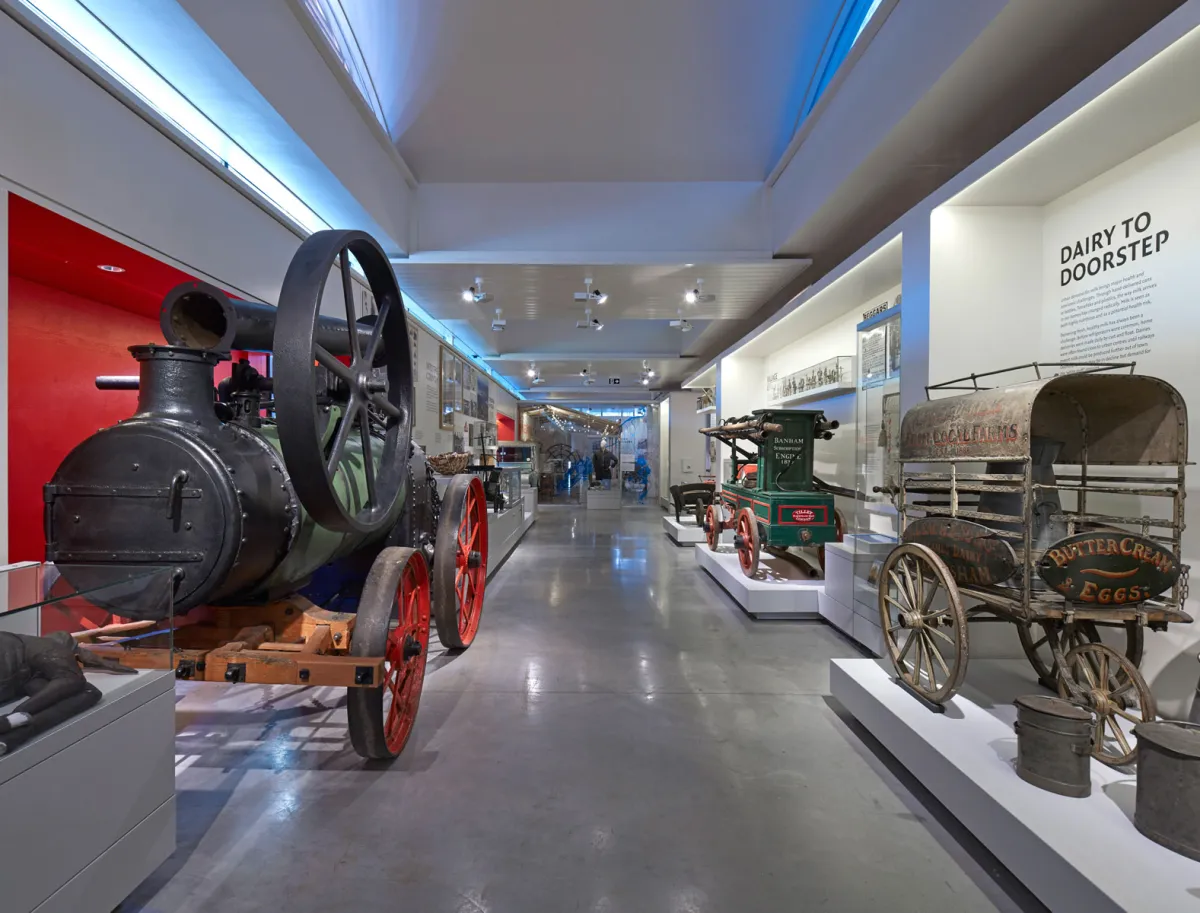 Photo: Museum of English Rural Life, via www.prsarchitects.com
Learning by Doing
Most of the people keeping this craft alive today came to it sideways. Margaret Hoskins, who runs workshops from her smallholding in Shropshire, was a textile artist before she picked up her first straw. "I thought it would be simple," she laughs. "It absolutely isn't. The basic plait takes ten minutes to learn and a year to do properly. And that's before you even attempt a spiral form."
The Straw Craft Circle, founded in the 1960s during the same wave of folk revival enthusiasm that brought traditional music roaring back into British consciousness, remains the primary network connecting makers across the country. Its members range from retired farmers who learned from parents and grandparents to younger craftspeople who discovered the tradition through living history projects or, increasingly, through social media.
That younger cohort matters. The average age of active corn dolly makers has been a source of quiet anxiety in the community for decades. But there are encouraging signs. Heritage craft organisations have begun listing straw plaiting and corn dolly making among the skills they're actively working to transmit, and a handful of agricultural colleges have started incorporating the tradition into wider programmes about rural heritage.
What Are We Really Preserving?
It's worth asking, though, what exactly is being kept alive here — and for whom. Industrial farming has made the ritual logic of the corn dolly essentially obsolete. No one today genuinely believes that plaiting the last sheaf will protect next year's yield. The combine harvester doesn't leave a final standing sheaf; it leaves a field of stubble.
Some makers are entirely comfortable with the craft as cultural memory — a beautiful, technically demanding object that connects us to agricultural rhythms we've otherwise severed. Others feel something more urgent. "When you make one," says Hoskins, "you're doing something that people in this landscape have done for thousands of years. That's not nothing. That's a thread."
There's also the question of what the craft teaches about attention. Making a corn dolly requires you to slow down, to feel the material, to work with your hands in a way that most modern life actively discourages. In that sense it belongs to a broader conversation happening across British folk culture right now — about what we lose when we outsource every physical skill, and what we might recover by reclaiming even a few of them.
The straw is patient. It waits to be plaited. And somewhere in the doing of it, in the particular focus that the work demands, something of the old rhythm returns — not as nostalgia, but as a genuine act of continuity with the people who worked these fields before us.
The spirit of the harvest, you might say, is still looking for somewhere to winter.