The Listening Workshop: Britain's Folk Instrument Restorers and the Voices They Rescue
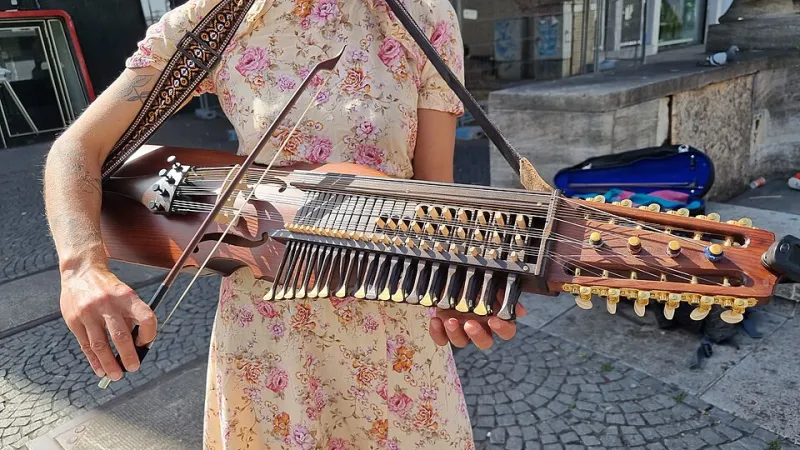
Photo: Bernd Schwabe in Hannover, CC BY-SA 4.0, via Wikimedia Commons
The fiddle arrived wrapped in a bin liner. Inside the bag was a cardboard box. Inside the box was a 1920s Scottish fiddle — two of its ribs cracked, its varnish worn to bare wood along the shoulder, its neck set at an angle that suggested someone had, at some point, tried to fix it themselves and not quite managed. The case it had once lived in was long gone. Nobody knew who had played it last.
Jenny Tait unwrapped it on her workbench in her workshop outside Inverness and spent about ten minutes just looking at it before she touched anything.
"You don't rush in," she says. "You look at everything first. The wear patterns, the repairs, the way the wood has moved. All of it's information."
What the Wood Remembers
Jenny has been restoring traditional Scottish instruments for nearly twenty years. Her workshop is a small converted outbuilding behind her house, every surface covered in tools, hide glue pots, clamps in various sizes, and instruments in various states of disassembly. On one shelf, three fiddles hang in a row like patients waiting to be seen. On the bench, a set of Scottish smallpipes is having its drones relined.
The work requires an unusual combination of skills: woodworking, acoustics, material history, and something harder to name — an ear for what an instrument is supposed to sound like, which means knowing the tradition it came from well enough to recognise when you've got it right.
"A Shetland fiddle and an Aberdeenshire fiddle are nominally the same instrument," Jenny explains, "but they've evolved in slightly different directions because of how they were played, what they were played for, the weather they lived in. If you restore one and make it sound like the other, you've failed, even if the repair itself is technically perfect."
The 1920s fiddle turned out to be from Speyside. She worked out the provenance partly from the style of the maker's label (partially legible), partly from the cut of the spruce on the top, and partly from conversations with a fiddle collector in Elgin who recognised the instrument from a photograph she sent him. It had belonged to a dance musician who'd played for reels and strathspeys in village halls across Moray. His granddaughter had found it in a loft.
Pipes, Harps, and the Harder Cases
Not all restoration work is as straightforward as a cracked rib and a misaligned neck. In a workshop in Hebden Bridge, Callum Rees specialises in what he calls "the awkward ones" — instruments that don't fit neatly into any category, that have been modified beyond recognition, or that represent traditions so obscure that sourcing authentic materials for a repair becomes a research project in itself.
He's currently working on a hurdy-gurdy that came to him from a folk musician who'd bought it at an estate sale in the Borders. It's probably mid-nineteenth century, probably French in origin, but it's been modified with components that suggest it was used in Britain for some time and adapted along the way. The wheel needs relining, two of the key boxes have been rebuilt clumsily, and the resonator has a crack that's been previously filled with what appears to be wood filler.
"Someone loved this instrument enough to try to fix it themselves when they couldn't afford a proper repair," Callum says, not unkindly. "You can't be angry about that. But it does mean I've got to unpick what they did before I can do what needs doing."
His approach to sourcing materials is painstaking. He keeps a network of contacts across Europe — instrument makers, timber merchants, specialist suppliers — and he maintains his own small stock of aged tonewoods, some of which he's been accumulating for fifteen years waiting for the right instrument to need them.
The Harp Question
In Devon, Siobhán Murray works almost exclusively with Celtic harps — lever harps, wire-strung harps, and the occasional gut-strung instrument that turns up from a private collection or a music school clearout. She came to the work via a background in early music performance, which means she approaches restoration with a performer's ear as well as a craftsperson's hands.
The wire-strung harp presents particular challenges. The tension exerted by wire strings is significantly greater than gut or nylon, which means the soundboard and neck take enormous stress over time. Old instruments often show warping, compression damage, or cracked soundboards that have been badly patched. Siobhán has developed her own methods for stabilising damaged soundboards that she's shared, carefully, with a handful of other restorers she trusts.
"There's no textbook for this," she says. "You share knowledge because you have to. If I solve a problem that someone else is going to face in ten years, it makes no sense to keep it to myself."
This informal network of knowledge-sharing is perhaps the most important thing happening in British folk instrument restoration right now. The community is small — probably no more than a few dozen people working at a serious professional level across the whole country — and the accumulated knowledge they hold is irreplaceable.
Keeping the Sound Alive
What unites these restorers, beyond their obvious technical skill, is a conviction that the instruments they work on are not merely objects. They're carriers of musical tradition, physical evidence of how communities once made music together, and — when restored properly — still capable of doing exactly what they were made to do.
The Speyside fiddle is playing again. Jenny set it up for the granddaughter, who had never played before, and watched her draw a bow across the strings for the first time. The sound it made was thin and uncertain — the sound of a beginner. But underneath that, Jenny could hear the instrument itself: warm, resonant, exactly right.
Somewhere in Moray, in a village hall that probably still exists, music very like that once made people get up and dance. It's not a stretch to say it could do so again.