Slow Writing on Old Stone: The Lichen Watchers Who Let Nature Keep the Records
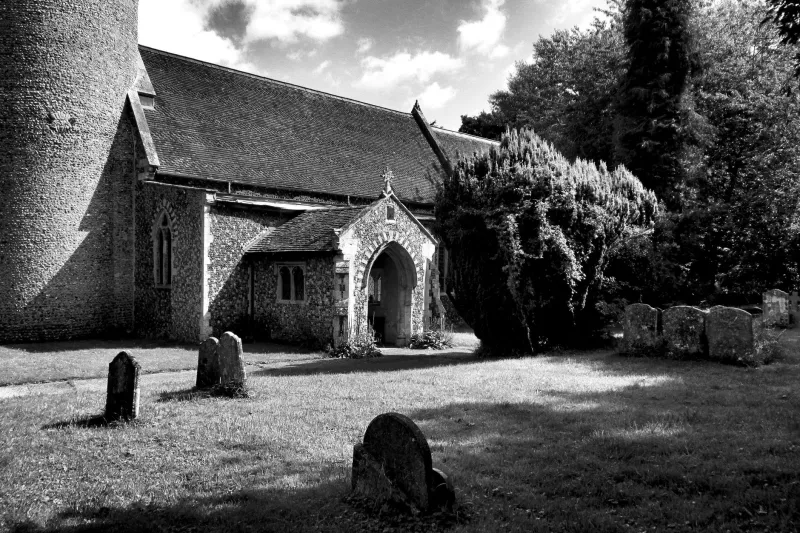
The gravestone is eighteenth century, sandstone, and covered in what looks, at first glance, like weather staining. Look closer, though — or rather, look the way Diane Fenwick looks, which is slowly, with a hand lens and a great deal of patience — and the surface resolves into something far more structured. Overlapping discs of grey-green, orange-red, and pale ash-white. Rosettes of yellow-grey that have been expanding, millimetre by millimetre, since before the stone was set. A crustose black lichen tracing the carved letters of a name that might otherwise have become illegible decades ago.
"The lichen is protecting the inscription," Diane says. "In a way, it's the reason we can still read it."
Diane is part of a loose network of naturalists and botanists who spend their time recording lichen across Britain's heritage sites — churchyards, ancient walls, stone circles, field boundaries, bridge abutments, and the mossy flanks of medieval buildings. Their work sits at an unusual crossroads: it's ecology, yes, but it's also a form of local history, environmental monitoring, and — though they'd probably be too modest to frame it this way — an act of cultural preservation.
What Lichen Actually Is
Lichen is not a single organism. It's a partnership — typically a fungus and a photosynthetic partner, usually algae or cyanobacteria — so intimate that the two function as one. They colonise surfaces that would defeat almost anything else: bare rock, old mortar, the polished face of a memorial stone. They grow extraordinarily slowly, some species expanding by less than a millimetre per year, which means that a lichen colony the size of a dinner plate may have been growing for centuries.
This slowness is, for the people who study them, one of their most remarkable qualities. Lichen communities on undisturbed stone surfaces are living records of time, each species and each colony a data point in an ongoing story about light, moisture, air quality, and the stability of the substrate beneath.
Britain has around 1,800 species of lichen, more per unit area than almost anywhere else in Europe, partly because of its mild, damp climate. Many of these species are found on ancient stonework, and the communities they form are, in some cases, as old as the structures they inhabit. When you disturb or remove lichen from old stone — as has happened, sometimes with good intentions, during insensitive restoration work — you don't just lose the organism. You lose the record it represents.
Reading the Community From the Stone
The ecological information encoded in lichen communities is substantial. Certain species are exquisitely sensitive to sulphur dioxide pollution; their presence or absence on urban stonework maps the history of industrial air quality with a precision that monitoring stations rarely achieve over comparable timescales. Others indicate the chemical composition of the stone itself, or the degree to which a surface is sheltered from rain, or the presence of particular minerals leaching from the ground below.
But the local historians in these networks are interested in another layer of information entirely: what lichen can tell you about the human history of a place.
A churchyard where the oldest stones are thickly colonised by slow-growing species, undisturbed over centuries, speaks of a community stable enough to maintain its burial ground in one place across generations. A wall where lichen communities have been disrupted — where raw stone shows through amid the older colonies — tells a different story: of repair, of disturbance, of change. A gravestone where the lichen growth pattern has been interrupted by the addition of a later inscription, or by the fixing of a memorial plaque, can sometimes be dated with surprising accuracy just by examining where the colonies have re-established and how far they've spread.
"It's like reading tree rings," says James Cartwright, a retired geography teacher who has been recording lichen in Derbyshire churchyards for fifteen years. "Except the tree is the whole landscape, and the rings go back much further."
The Volunteers Who Watch
The British Lichen Society coordinates much of the formal recording work, but the network of people actually doing the fieldwork is broader and less structured than any single organisation. Local natural history societies, wildlife trusts, and individual enthusiasts contribute records to national databases, building up a picture of distribution and change that no professional research programme could afford to compile on its own.
What characterises the best of these recorders is a quality of attention that's become unusual. They are, by necessity, people who can sit with a hand lens in front of a damp churchyard wall for an hour and find that time well spent. They notice things — a slight change in the colour of a colony at its margin, the presence of a reproductive structure no larger than a pinhead, the way one species is advancing across another in a slow-motion territorial dispute that has been playing out since the reign of George III.
This quality of attention is itself a kind of knowledge, and it's one that transfers readily to other forms of local observation. Many of the lichen recorders in these networks are also the people who notice when a hedgerow has been removed, when a field pond has been drained, when the old stone stile on the footpath has been replaced with a metal kissing gate. They are, in the most literal sense, people who have learned to read the landscape.
Heritage Sites as Ecological Refuges
One of the more surprising findings to emerge from sustained lichen recording is the ecological significance of Britain's churchyards and historic sites. Protected from disturbance, often unsprayed, and containing stonework of various ages and compositions, these sites have become refuges for species that have disappeared from more intensively managed landscapes.
In some areas, the lichen communities on old churchyard walls are among the most diverse in the region — richer, in terms of species, than nearby nature reserves. This makes them ecologically important in ways that heritage management frameworks have been slow to recognise. A churchyard managed sensitively for its lichen is also, almost certainly, better managed for its mosses, its invertebrates, and the birds and bats that depend on them.
The lichen recorders have been making this case, quietly and persistently, to local churches, parish councils, and historic environment bodies. Progress is slow — slower, perhaps, even than lichen growth — but there are signs that the argument is landing. Several dioceses have issued guidance on lichen-sensitive churchyard management. Historic England has begun incorporating lichen survey requirements into some conservation frameworks.
What the Slow Record Shows
There's a philosophical dimension to this work that its practitioners sometimes articulate when they're in a reflective mood. Lichen operates on a timescale that makes human history feel brief. A colony that was already mature when the church beside it was built has watched the Reformation, the Civil War, industrialisation, and two world wars without, as far as it's concerned, anything particularly noteworthy happening. It has its own priorities.
Working alongside something that patient changes you, the recorders say. It recalibrates your sense of what matters and what doesn't, what's permanent and what's passing. The communities that built these walls and carved these stones thought they were making something lasting. The lichen, measuring time in millimetres, is the only thing still keeping score.
Diane packs her hand lens away and straightens up from the gravestone. The name beneath the lichen is a local surname — she recognises it from the parish registers she's also been helping to digitise. A thread connecting the living record on the stone to the written record in the vestry. Two archives, one biological, one textual, both telling the same story from different angles.
"We're all just reading the same place," she says. "Just in different languages."