The Doctor Will See You Now: Why Britain's Mummers Still Knock on Midwinter Doors
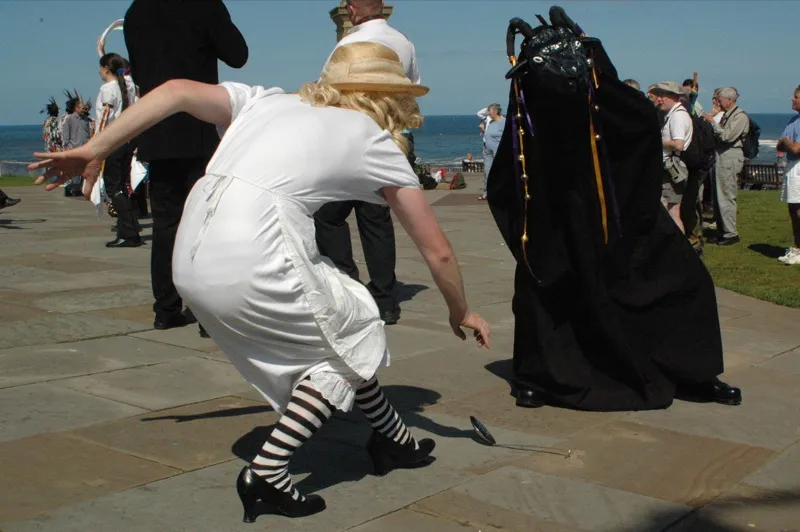
Photo: Bryan Ledgard, CC BY 2.0, via Wikimedia Commons
There's a particular noise a hobby horse makes when it comes through a pub door: half clatter, half wheeze, entirely uninvited. In a village hall somewhere in the Midlands on a wet Tuesday in early December, a dozen adults are stood in a rough circle arguing about it. The horse is a real horse's skull on a pole, dressed in a shawl, and it has been in the troupe longer than most of the troupe has. The argument is not about whether the horse should enter. The argument is whether the horse should enter before the Doctor, or after.
This is mumming season, and it has been for about four hundred years.
What actually happens on the doorstep
For anyone who has never seen one, the mummers' play is a piece of winter folk theatre with a plot that would baffle a script editor. A hero — usually St George, sometimes a local variation with a different name — issues a challenge. A rival, most often the Turkish Knight (or Bold Slasher, or the Black Prince) accepts it. They fight in rhyming couplets. One of them falls down dead. A quack doctor is summoned, arriving with a bag, a bottle and an outrageous claim about his credentials, and brings the corpse back to life. Then a series of comic figures push their way in: Beelzebub with his club, Father Christmas with his appeal to the audience, Little Johnny Jack with a bundle of dolls on his back representing his family and his poverty.
The whole thing is done in a circle, with no stage, no curtain and no fourth wall. The audience is standing on the same tarmac as the actors, often holding a plastic cup, often blocking the exit.
And then somebody rattles a collection tin.
Nine pages, half-remembered, fiercely defended
The scripts vary wildly. Lancashire and Yorkshire have their Pace Egg plays, performed nearer Easter. Cornwall has its Guize dancers. Scotland has Galoshins. Every troupe's text has been copied from a photocopy of a photocopy, with a line in the middle that nobody can explain and one character who was added by a man called Derek in 1988 and has never been removed.
'We have three versions in the box and we don't agree about which is the proper one,' says one organiser of a long-running Border-side troupe. 'The one we perform is the one we can all remember. That's the tradition. The tradition is whatever survived the car journey.'
That's not as flippant as it sounds. These plays were rarely written down in their earliest form; they were carried in heads, misheard, misremembered, corrected by someone's grandmother and then written out by hand on the back of a feed merchant's invoice. The variation isn't a flaw in the tradition. It is the tradition.
The costume box is the real archive
Ask a troupe about its costumes and you'll get a tour of Britain's charity shops. Curtains become cloaks. A tinsel wig becomes Father Christmas. The Doctor's top hat came from a house clearance and smells faintly of a loft. Someone's mother stitched the horse's shawl in 1994 and it has been repaired six times, always badly, always with affection.
One thing has changed. The blacking — soot, cork or burnt cork — that once darkened faces in some mumming and Border morris traditions has been quietly retired by a number of sides, replaced by masks, sashes or nothing at all. Troupes describe it as a decision taken locally, sometimes after a long and not entirely comfortable conversation, rather than a rule handed down. In a form this old, that's how most change arrives: reluctantly, by argument in a back room, and then everyone gets on with the play.
The argument about stage left
The rehearsal is the funniest part of mumming and nobody outside the troupe ever sees it. There is usually no director. There is usually someone who has decided, by sheer force of personality, to behave like one. There is always a person who knows the play is traditionally performed in the round and therefore objects to any suggestion that anyone should stand anywhere in particular.
Blocking, in these circumstances, is a negotiation roughly as formal as a village green boundary dispute. The Doctor enters where the Doctor has always entered. The Doctor's bag is on the wrong side. The Doctor's bag is now on the correct side, and the sword dance has gone wrong as a result. The horse is complaining about the puddle.
And then, on the night, it works. Not perfectly. Never perfectly. But the audience fills the gaps the way audiences have always filled them: by knowing roughly what's coming and being delighted when it arrives.
Why it still lands in 2026
There is a temptation to treat all this as preservation, as though the plays were jars in a pantry. But the troupes still knocking on doors this winter are not primarily interested in heritage. They are interested in the thing heritage is for: a street full of neighbours, a reason to learn lines in November, a collection for the village hall roof, and the very specific pleasure of being on the same level as the people watching you.
You can't scroll a mummers' play. It happens at the speed of a man in a top hat telling you, at length, about a journey from Italy. Children who have been dragged along end up in the cast within two or three years. That's how these troupes survive — not by recruiting, exactly, but by absorbing.
Dates vary by troupe: some go out on Boxing Day, plenty mark Twelfth Night, others wait for Plough Monday in January. If you want to find one, ask in the pub before you ask online. If you want to join one, the answer is almost always yes, and the only qualification is a willingness to be shouted at by a horse.