Under the Same Stars: The Amateur Astronomers Watching Ancient Skies Come Back to Life
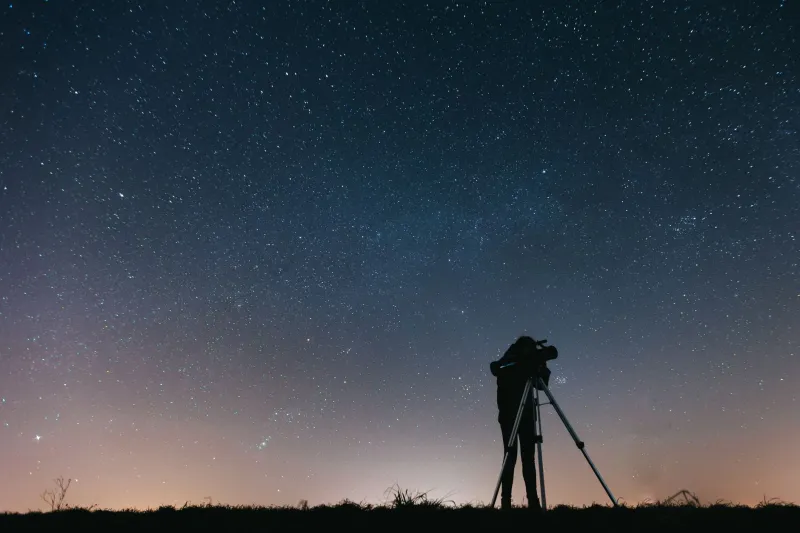
There's a particular kind of silence that settles over Bodmin Moor around midnight in January. The wind drops, the last farm light disappears behind a hill, and if the cloud cover cooperates — always a gamble in Cornwall — the sky opens up into something that stops you mid-breath. Standing among the Hurlers, three Bronze Age stone circles arranged in a near-perfect line, you begin to understand why someone once went to the extraordinary trouble of hauling granite across a landscape to mark this exact spot.
Mike Trevorrow has been standing in fields like this for the better part of twenty years. A retired civil engineer from Bodmin, he carries a battered notebook, a Dobsonian reflector telescope, and a quiet conviction that the people who placed those stones were paying attention to the same sky he's watching now.
"They didn't have our instruments," he says, adjusting his red-filtered headtorch so it doesn't ruin his night vision. "But they had something we've almost entirely lost — uninterrupted access to the sky. Every night, for their whole lives. That kind of accumulated observation is a form of knowledge we can barely imagine now."
The Light That Drowns Everything
Britain is one of the most light-polluted countries in Europe. According to the Campaign for Dark Skies, roughly 80 per cent of the UK population can no longer see the Milky Way from where they live. The orange glow of towns bleeds outward across counties, softening horizons, flattening the night into something dull and featureless. For most people, the stars have become a vague concept rather than a lived experience.
But a growing network of amateur astronomers is pushing back, and they're doing it from some of Britain's most storied prehistoric locations. The Cairngorms, Dartmoor, the Preseli Hills in Pembrokeshire, Orkney's West Mainland — these are places where the darkness is still real, and where the alignments of ancient monuments give modern observers something extraordinary to work with.
The Dark Sky Discovery Network, along with local astronomy societies dotted across the country, has been quietly building a map of observation points near heritage sites. It's not an official programme, more a loose fellowship of enthusiasts who share notes, compare photographs, and occasionally gather in a freezing field to watch a solstice sunrise together.
"It started almost by accident," says Cath Meredith, who coordinates a small group of observers in the Brecon Beacons. "A few of us were already visiting these sites because we love the history. Then someone brought a telescope. Then someone else started reading about archaeoastronomy. And gradually we realised we were doing something that felt genuinely connected to the original purpose of the places."
Reading What Was Already Written
Archaeoastronomy — the study of how ancient cultures understood and incorporated astronomy — has moved from the fringes of academic inquiry towards something approaching mainstream respectability over the past few decades. Sites like Stonehenge, Callanish on the Isle of Lewis, and the Maeshowe passage tomb in Orkney are now understood not simply as ceremonial spaces but as precision instruments for tracking celestial events: solstices, lunar standstills, the rising of specific stars.
What the amateur observers bring to this conversation isn't academic rigour — most of them would be the first to say so — but something more embodied. They're out there in the cold, over multiple seasons, watching the sky shift. They see things that don't necessarily make it into papers.
Dave Ashworth, a postman from Skipton who has been observing from the Yorkshire Dales for fifteen years, keeps meticulous records of what he sees from a cluster of Bronze Age cairns above Grassington. His notebooks are filled with observations about horizon events — moments when a star or planet appears to rise or set in direct alignment with a stone feature.
"I'm not claiming I've cracked anything," he says carefully. "But there are moments when the alignment is so precise that it doesn't feel accidental. You think: somebody noticed this. Somebody was standing here, watching exactly what I'm watching, and they built something to remember it by."
The Fight for Darkness
The practical battle these observers are fighting is against the relentless creep of artificial light. New housing developments, upgraded road lighting, agricultural floodlights, and the proliferation of LED street lamps — often installed with the best intentions around energy efficiency — are steadily eroding the remaining dark zones.
Several of the group have become unlikely advocates, attending parish council meetings, writing to local authorities, and working with the International Dark-Sky Association's UK arm to push for better lighting design in sensitive areas. It's unglamorous work, often frustrating, but the stakes feel real.
"If you lose the dark sky," says Cath, "you lose the ability to understand why those monuments were placed where they were. You can still see the stones, but they become mute. The context disappears."
There have been some genuine victories. Exmoor became the UK's first International Dark Sky Reserve in 2011, and the Brecon Beacons followed. Galloway Forest Park in Scotland holds the same designation. In each case, local communities and councils worked together to reduce unnecessary light emission and protect what remains.
Something the Ancestors Understood
What strikes you most, spending a night out with these observers, isn't the equipment or the technical knowledge — though both are impressive. It's the quality of attention. There's no rushing, no scrolling, no ambient noise. Just sustained, patient looking.
Mike Trevorrow talks about this as a kind of practice, almost meditative in character. "Our ancestors couldn't outsource their relationship with the sky to an app. They had to look. Night after night. That looking became part of how they organised time, how they understood their place in things, how they built their rituals. We've lost that, mostly. But it's still available to us, if we're willing to go and stand in the cold for a few hours."
As the Pleiades climb above the eastern ridge of the moor and the Hurlers stand in their ancient arrangement below, it's hard to argue with him. The stones aren't mysterious because we don't understand them. They're mysterious because we've forgotten how to look at what they were looking at.
The night watchers are remembering. One clear sky at a time.