Rope, Ring and Reckoning: Inside the Bell Towers Where England Still Speaks
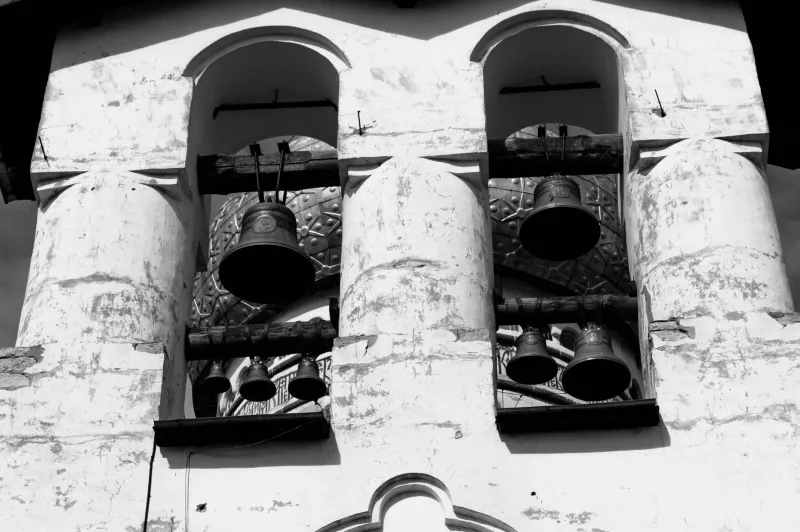
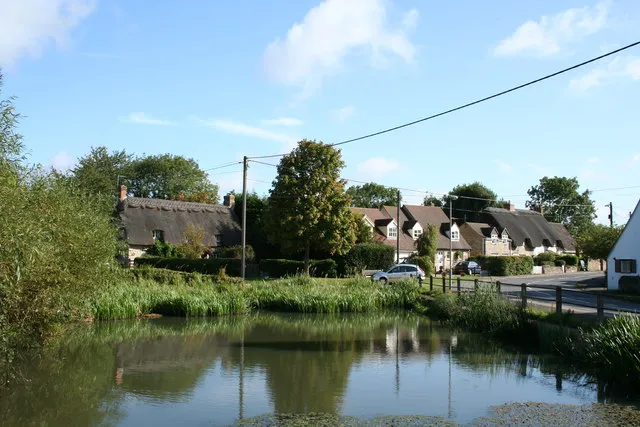
You hear it before you understand it. That cascading tumble of bronze voices rolling across a village green on a Sunday morning — not quite melody, not quite noise, but something in between that lodges in the chest like a half-remembered dream. The pealing of church bells is so embedded in English life that most people absorb it without thinking, the way you absorb the smell of cut grass or the sound of rain on a pub roof.
But climb the narrow staircase inside almost any English parish church tower, and you'll find a room that operates by its own rules entirely.
The Chamber at the Top of the Stairs
The ringing chamber at St Mary's in the Wiltshire village of Steeple Ashton smells of rope oil, old wood and something faintly electrical — the residual hum of bells that have been rung here, in various configurations, since the fifteenth century. Six ropes hang in a neat circle from the ceiling, each one colour-coded with a strand of wool near the sally — the fluffy, grippy section a ringer grabs to set the bell in motion. The floor is worn smooth in precise spots, feet having stood in the same positions for generations.
 Photo: Steeple Ashton, via c8.alamy.com
 Photo: St Mary's, via stmaryscathedral.org.au
"Most people imagine we're just pulling ropes up and down randomly," says Margaret Holloway, who has been ringing here for thirty-one years and now leads the local branch of the Central Council of Church Bell Ringers. "They don't realise we're working through mathematical sequences. Every bell changes position relative to every other bell. It's like solving a puzzle, except the puzzle makes a sound and the sound fills the whole valley."
Change ringing — the distinctly English practice of ringing bells in controlled, ever-shifting permutations — has no real equivalent anywhere else in the world. The Belgians have carillons. The Dutch have their own traditions. But the full-circle ringing of tower bells in complex mathematical orders is, stubbornly and gloriously, an English invention, codified in the seventeenth century and refined ever since through an oral and physical tradition passed from hand to hand across the centuries.
An Unlikely Fellowship
What strikes a visitor to any active ringing chamber is the sheer improbability of the gathering. At Steeple Ashton on a Tuesday practice night, the group includes a retired dairy farmer who started ringing after his wife died and needed something to fill the evenings, a twenty-four-year-old software engineer who heard about it through a folk music forum, a secondary school music teacher, and a woman in her seventies who has been ringing since she was twelve and can still call a Plain Bob Doubles from memory without pausing for breath.
This is, it turns out, fairly typical. Bell ringing has always attracted an eclectic crowd — it demands mental agility, physical coordination, and an almost meditative capacity to listen while simultaneously calculating. It is, in that sense, closer to improvised folk music than to any purely athletic pursuit.
"The folk connection is real," says Tom Greaves, the software engineer, who plays concertina in a session band in Bath. "There's a similar kind of group listening involved. You're not just executing your own part — you're constantly adjusting to what everyone else is doing. The sound you're making together is the point."
The Revival Nobody Announced
The ringing community has faced genuine pressures in recent decades. Ageing memberships, the closure of some rural parishes, the perception that bell ringing belongs to a fading ecclesiastical world — all of these have gnawed at the tradition. Yet the numbers tell a more complicated story. Across England, the Association of Ringing Teachers reports consistent upticks in new learner registrations since 2018, with particular growth in younger age groups and urban centres.
Some of this is driven by the folk revival more broadly. As interest in traditional crafts, oral history and pre-digital community has deepened, bell ringing has started to look less like a dusty church obligation and more like exactly the kind of embodied, social, heritage-rooted practice that people are actively seeking.
"I think people are hungry for something that connects them to place," says Reverend David Okafor, whose parish in rural Shropshire has seen its ringing tower go from three elderly members to twelve active ringers in four years. "Bell ringing is intrinsically local. The bells in this tower have been rung by people from this community for five centuries. When you ring them, you're not just making music — you're joining a very long conversation."
Reading the Sound
There is a vocabulary to change ringing that takes time to learn, and it is worth pausing over. A 'peal' is a full performance of more than five thousand changes — roughly three hours of continuous ringing. A 'quarter peal' runs to around forty-five minutes. A 'method' is a specific sequence pattern, and there are hundreds of them, each with its own name: Grandsire, Stedman, Cambridge Surprise, Plain Bob. These names carry history — some date to the seventeenth century, coined by the early theorists who first attempted to systematise what had previously been passed on by instinct.
The language of ringing is also deeply communal. 'Rounds' — the simplest sequence, bells ringing in order from highest to lowest — is where every beginner starts and where every ringing session ends. There's something almost ceremonial about coming back to rounds: a return to order after complexity, a resolution that feels, to anyone who has spent time in a ringing chamber, genuinely satisfying.
Dry Stones and Resonant Towers
What bell ringing shares with so many of the traditions this site returns to again and again is a quality of persistence through practice — the sense that the craft exists not in archives or museums but in the bodies and habits of living people. You cannot preserve change ringing by writing it down. You can notate the methods, record the terminology, document the history. But the tradition itself only survives in the room at the top of the tower, with ropes in hand and ears fully open.
For Margaret Holloway, that's precisely the point. "When I started, my teacher had learned from someone who'd learned from someone who'd been ringing since before the Second World War," she says. "That chain doesn't have to end. But it only continues if people climb the stairs."
The bells of Steeple Ashton ring out across the valley on a clear evening, and for a moment the sound seems to belong to no particular era — too ancient to be modern, too alive to be historical. That, perhaps, is the truest definition of a living tradition.