Silver Tides and Ancient Trades: How Britain's Herring Curers Built a Culture in Smoke
The Silver Darlings Return
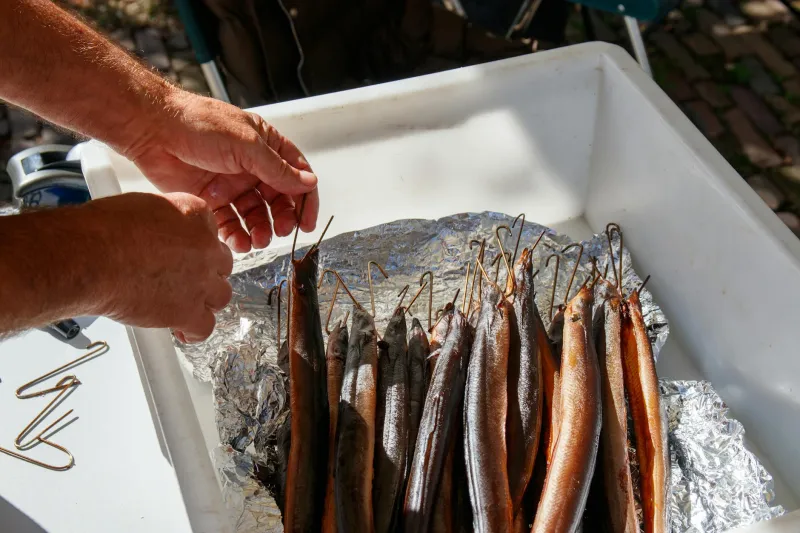
In a weathered shed overlooking the North Sea, Margaret Sinclair tends to rows of herring suspended like silver prayers above smouldering oak chips. The fish hang in perfect formation, their scales catching the filtered light that seeps through gaps in the timber walls. This is Craster, Northumberland, where the art of kipper curing has passed through five generations of the same family — a living thread connecting today's breakfast tables to the great herring boom that once made fortunes and fed nations.
"People think it's just about the smoke," Margaret says, adjusting a damper with the practiced ease of someone who's spent decades reading the subtle language of temperature and airflow. "But it starts with the salt. Always the salt."
The herring trade built entire civilisations along Britain's eastern coastline. From the Shetland Isles to Great Yarmouth, communities organised their entire existence around the seasonal arrival of vast shoals that turned the North Sea silver. Women worked in gangs of three — the gutter, the packer, and the salter — processing thousands of fish in a single day during the height of the season. Their techniques, refined over centuries, created not just preserved fish but entire social structures, work songs, and local dialects that still echo in coastal towns today.
Salt Wisdom and Women's Work
The revival of traditional herring curing isn't just about nostalgia — it's about recovering knowledge that industrial processing nearly erased. In Lowestoft, where the last of the great herring fleets once landed their catches, Sarah Thompson has spent three years learning techniques that her great-grandmother would have known by heart.
"The old women could tell the quality of salt just by running it through their fingers," Sarah explains, demonstrating the proper way to layer fish in wooden barrels. "They knew which tides produced the best fish, how moon phases affected the cure, when to add more salt and when to trust time to do its work."
These weren't mere superstitions but accumulated wisdom about microclimates, bacterial action, and the complex chemistry of preservation. The women who worked the herring trade developed their own vocabulary — words for different stages of decomposition, terms for the perfect balance of salt and moisture, phrases that described the exact colour of properly smoked skin.
The Geography of Smoke
Each curing region developed its own signature, shaped by local conditions and available materials. The Norfolk coast produced delicately flavoured bloaters, cold-smoked over gentle oak fires. Scottish kippers gained their robust character from Highland peat and birch. Manx kippers, cured on the Isle of Man, carried hints of the sea salt that permeated every coastal building.
 Photo: Isle of Man, via a.cdn-hotels.com
"You can't separate the fish from the place," says James MacLeod, who runs one of the last traditional smokehouses in Mallaig. "Our ancestors understood that the best cure wasn't just about following a recipe — it was about reading the weather, knowing your wood, understanding how the stone walls of your smokehouse held and released heat."
MacLeod's smokehouse, built in 1876, still operates on the principles established by his great-great-grandfather. No thermostats, no electric fans — just the accumulated knowledge of how North Atlantic winds interact with Highland oak smoke, how the granite walls store and release heat, how the position of the moon affects the salt's ability to draw moisture from fish flesh.
Songs in the Smoke
The herring trade created its own musical tradition, work songs that helped coordinate the rapid, repetitive motions required to process vast quantities of fish. These weren't quaint folk ditties but functional music — rhythms that helped three-woman teams maintain the precise timing needed to gut, pack, and salt hundreds of herring per hour.
"My grandmother used to sing while she worked," remembers Agnes Robertson, whose family ran a curing station in Fraserburgh for over a century. "Different songs for different stages of the work. The gutting song was quick and sharp, like the knives. The packing song was slower, more careful. And when they were waiting for the cure to take hold, they'd sing the old ballads — stories of fishermen lost at sea, of women waiting on the harbour wall."
Some of these work songs are being recorded for the first time, collected by folklorists who recognise their importance as both musical heritage and industrial archaeology. The rhythms encoded generations of accumulated technique, while the lyrics preserved local history, weather lore, and the complex social relationships that bound fishing communities together.
The New Curers
Today's herring curers work in a different world, but they're discovering that the old techniques produce flavours impossible to achieve through industrial methods. The slow, patient process of traditional curing creates complex chemical compounds that give properly smoked fish its distinctive depth and character.
"Modern smoking is all about speed and consistency," explains David Morrison, who left a career in food science to revive his family's abandoned smokehouse in Arbroath. "But the old way produces something completely different — fish that tastes of the sea and the shore, of oak smoke and time itself."
Morrison works with local fishing boats to source herring caught using traditional methods, supporting a network of small-scale fishermen who understand the connection between catching techniques and curing quality. His customers include high-end restaurants, but also local families who remember what properly cured herring should taste like.
Preserving the Knowledge
The revival of herring curing faces practical challenges. Finding suitable buildings with the right combination of stone walls, proper ventilation, and proximity to fresh fish supplies isn't easy. The knowledge itself is fragmented — techniques passed down through families, written records scattered across maritime museums and local history societies.
But perhaps the biggest challenge is cultural. The herring trade wasn't just about food production — it was about community identity, seasonal rhythms, and the deep connection between coastal people and the sea that sustained them. Reviving the techniques means more than learning to smoke fish; it means understanding a way of life that organised entire communities around the ancient dance of tide, season, and shoal.
In smokehouses from Shetland to Norfolk, a new generation of curers is discovering that this knowledge isn't just historically interesting — it's practically valuable. As consumers seek alternatives to industrial food production, the patient wisdom of the herring curers offers something that no factory can replicate: fish that carries the taste of place, the knowledge of generations, and the enduring connection between Britain and the silver-bright sea that surrounds it.