The Keepers of the Ancient Covenant: Why Britain's Beekeepers Still Whisper to Their Hives
The Conversation That Never Ended
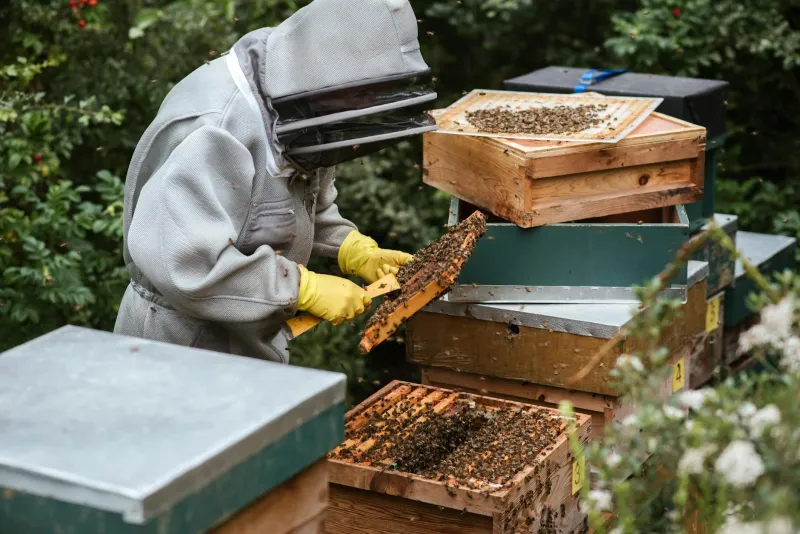
On a grey October morning in a Dorset village, Margaret Thornfield walks slowly towards her row of wooden hives. She carries no smoker, no protective veil – just a heavy heart and words that must be spoken. Her husband of forty-three years died three days ago, and according to a tradition older than the Norman Conquest, the bees must be told.
 Photo: Margaret Thornfield, via blogger.googleusercontent.com
"Good morning, my dears," she whispers, tapping gently on the nearest hive. "I've come to tell you that John has passed. He's gone to his rest, but I'm still here. I'll still care for you."
This is 'telling the bees' – one of Britain's most persistent folk customs, practised quietly in gardens from Cornwall to the Highlands by beekeepers who understand that some relationships transcend the merely practical. It's a tradition that reveals something essential about how our ancestors viewed the natural world: not as property to be managed, but as community to be respected.
Ancient Agreements
The custom of telling the bees appears in British folklore as early as the medieval period, though its roots likely stretch back to pre-Christian times. The practice was simple but inviolable: any significant event in the household – births, deaths, marriages, departures – must be formally announced to the bees. Failure to observe this courtesy risked the bees abandoning their hives or, worse, bringing misfortune to the family.
"It wasn't superstition in the way we understand it," explains Dr. Fiona MacLeod, a folklorist at Edinburgh University who has studied British bee customs for over a decade. "It was practical psychology dressed in ritual. Bees were valuable livestock, often a family's most precious asset after land itself. The custom ensured they received proper attention during times of household upheaval."
The tradition took different forms across Britain. In some regions, hives were draped with black cloth during mourning periods. Welsh beekeepers would sing hymns to their bees during religious festivals. Scottish Highlanders believed bees must be invited to family weddings or they would swarm in protest.
The Hive Mind
What makes the tradition remarkable is not its antiquity but its persistence. Despite centuries of agricultural modernisation, urbanisation and scientific advancement, telling the bees refuses to die. From suburban back gardens to commercial apiaries, beekeepers continue the practice – some inheriting it from grandparents, others adopting it after discovering its emotional power.
"I started telling my bees about ten years ago, after reading about it in an old beekeeping book," says James Crawford, who maintains six hives behind his cottage in the Cotswolds. "I thought it was charming nonsense. But the first time I did it – announcing my daughter's engagement – something shifted. It felt right. It felt necessary."
Crawford's experience echoes that of many modern practitioners. What begins as historical curiosity often evolves into genuine spiritual practice. The bees become confidantes, witnesses to life's passages, silent partners in the human journey.
Science and Soul
Modern beekeeping has embraced scientific management techniques that would astound medieval apiarians. Varroa mite treatments, artificial insemination of queens, computer-monitored hive conditions – today's beekeepers deploy technology their predecessors couldn't imagine. Yet many of these same scientifically-minded practitioners maintain the ancient custom of formal communication with their colonies.
"There's no contradiction," insists Dr. Sarah Bennett, a entomologist and commercial beekeeper who manages over 200 hives in Hampshire. "I understand bee biology, pheromone communication, colony dynamics. But I also understand that beekeeping is fundamentally a relationship. The telling tradition acknowledges that relationship."
Recent research into bee cognition has revealed remarkable complexity in hive behaviour. Bees demonstrate learning, memory, and even primitive forms of culture passed between generations. They respond to their keeper's presence, recognise individual humans, and appear to sense emotional states through subtle chemical and behavioural cues.
"Perhaps our ancestors were more perceptive than we assumed," suggests Dr. Bennett. "They recognised that bees are aware, responsive creatures deserving of courtesy and consideration."
Living Tradition
The practice of telling the bees has found new expression in contemporary Britain. Folk musicians incorporate bee-telling ceremonies into seasonal festivals. Garden beekeepers share their experiences through online forums, comparing regional variations and personal adaptations of the tradition. Some urban apiaries have adopted formal telling protocols, ensuring continuity when individual beekeepers move or retire.
At the London Beekeepers' Association, secretary Michael Harrison maintains detailed records of member practices. "About thirty percent of our beekeepers report some form of telling tradition," he notes. "It's not correlated with experience level or scientific training. It seems to emerge naturally from close observation of bee behaviour."
The custom has even influenced modern beekeeping literature. Contemporary guides increasingly acknowledge the emotional and psychological dimensions of hive management, recognising that successful beekeeping requires intuition as well as technique.
Beyond Superstition
What emerges from conversations with bee-tellers is not primitive animism but sophisticated understanding of interdependence. The tradition recognises that humans and bees exist in genuine partnership – each species benefiting from the other's presence, each affected by the other's wellbeing.
"When I tell my bees about family events, I'm acknowledging their place in our lives," explains Margaret Thornfield, still tending her Dorset hives six months after her husband's death. "They're not just honey producers. They're part of our household, our landscape, our continuity."
This perspective resonates particularly strongly in an era of environmental crisis and species decline. As Britain's wild bee populations face unprecedented pressures from habitat loss, pesticides and climate change, the tradition of telling the bees serves as a reminder of our responsibility to non-human communities.
The Unbroken Thread
On summer evenings across Britain, in cottage gardens and city allotments, the quiet conversations continue. Beekeepers sharing news of grandchildren and griefs, celebrations and sorrows, maintaining a dialogue that stretches back through centuries of British life.
"People ask if I really believe the bees understand," says James Crawford, watching the evening flight patterns around his Cotswolds hives. "That misses the point entirely. The question isn't whether they understand our words. It's whether we understand our relationship. The telling tradition keeps that understanding alive."
In a world increasingly disconnected from natural rhythms, the custom of telling the bees offers something precious: a practice that honours both scientific knowledge and ancestral wisdom, that recognises the intelligence of other species while acknowledging the limits of our own understanding.
As dusk settles and the last foragers return to their hives, the ancient covenant continues. Human voices whispering to buzzing darkness, maintaining a conversation that began when Britain was young and shows no sign of ending. In that persistent dialogue lies something essential about what it means to live responsibly on this island – not as conquerors of nature, but as participants in its ongoing story.