Voices in Stone: The Master Carvers Keeping Wales's Slate Poetry Tradition Alive
The Dinner Hour Artists of Dinorwic
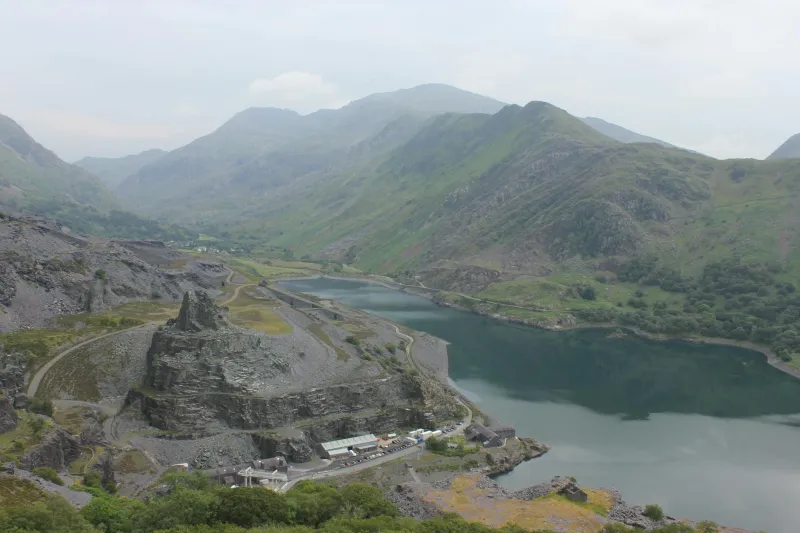
High on the terraced slopes of Dinorwic quarry, where slate once cascaded down the mountainside in thunderous avalanches, Gareth Williams runs his fingers across a fragment of stone no bigger than a dinner plate. Carved into its dark surface, barely visible unless you know how to look, are the faint outlines of a sailing ship, its rigging picked out in delicate detail.
 Photo: Dinorwic quarry, via www.hoodamath.com
"My grandfather carved this during his dinner break in 1952," Williams explains, his voice carrying across the silent workings. "Him and his gang would sit here eating their bread and cheese, and instead of resting, they'd create. Ships, portraits, poetry — anything that came to mind."
This was the hidden culture of the Welsh slate industry: quarrymen who spent their brief respites from brutal labour transforming offcuts into art. Now, sixty years after the last great quarries fell silent, a small but passionate group of artists and historians are racing to preserve not just the techniques, but the spirit of this remarkable tradition.
When Work Became Art
The slate carving tradition emerged from the particular rhythms of quarry life. Workers would arrive before dawn, blast and split stone until midday, then gather in sheltered spots to eat and rest. With slate fragments scattered everywhere and simple tools at hand, it was perhaps inevitable that some would begin to decorate the discarded pieces.
What made the tradition remarkable wasn't just its ubiquity — almost every quarryman tried his hand at carving — but its sophistication. These weren't crude scratches but accomplished works of art: detailed portraits of loved ones, intricate Celtic knotwork, verses of poetry in Welsh and English, even elaborate memorial tablets for deceased workmates.
"The quality was extraordinary," says Dr Marian Gwyn, who has spent decades documenting the tradition. "These men had no formal training, but they developed techniques that professional stonemasons would admire. They understood the grain of the slate, how to work with its natural properties rather than against them."
Learning from the Last Generation
Today, only a handful of people remember the tradition firsthand. Iestyn Garlick, now in his eighties, started as an apprentice at Penrhyn quarry in the 1950s and learned carving from men who had worked the slate for decades.
 Photo: Penrhyn quarry, via www.apotek1.no
"It wasn't something you were taught formally," he recalls, demonstrating the proper grip on a carving chisel. "You watched the older men, you asked questions, you practised on your own pieces. Some had the touch for it, others didn't. But everyone tried."
Garlick has become an unlikely teacher, passing on techniques to a new generation of artists who see slate carving as both craft and cultural preservation. His pupils include professional sculptors, amateur enthusiasts, and former quarry workers' descendants eager to connect with their heritage.
Among them is Sarah Davies, a contemporary artist who stumbled across the tradition while researching her family history. "My great-grandfather worked at Ffestiniog for forty years," she explains, carefully shaping a piece of purple slate. "When I found examples of his carving in the family attic, I knew I had to learn how he made them."
The Politics of Preservation
The revival of slate carving carries deeper significance than mere craft preservation. The Welsh quarries were sites of intense industrial struggle, where workers fought for better conditions, fair wages, and the right to use their native language. The carving tradition represents a form of cultural resistance — workers asserting their creativity and identity in the face of harsh industrial discipline.
"This wasn't just art for art's sake," argues historian Delyth George. "It was working-class people claiming their right to beauty, to self-expression, to culture. In a world that saw them only as units of labour, they insisted on being recognised as complete human beings."
This political dimension hasn't been lost on contemporary practitioners. Many see their work as a form of memorial, keeping alive not just techniques but values: collective creativity, mutual support, the belief that everyone deserves access to artistic expression regardless of their formal education or social class.
Tools, Techniques and the Touch of Stone
Slate carving requires minimal equipment but maximum sensitivity. The basic tools — a sharp chisel, a light hammer, perhaps a file for finishing — haven't changed in centuries. What matters is understanding the stone itself: how it splits along its natural grain, how pressure and angle affect the cut, how to work with rather than against its inherent properties.
"Slate is unforgiving," explains master carver Dylan Thomas (no relation to the poet, though the coincidence delights him). "One wrong move and your piece is ruined. But when you get it right, when you feel the stone responding to your touch, there's nothing quite like it."
The carving process demands patience and planning. Unlike softer stones that can be corrected, slate allows no second chances. Designs must be carefully mapped out, techniques practised on test pieces, every cut considered and deliberate.
Contemporary Echoes
Today's slate carvers work in a very different world from their quarrying predecessors. Where the original tradition emerged from industrial necessity, contemporary practice is consciously chosen, often pursued alongside other careers or as retirement projects.
Yet the fundamental impulse remains the same: the desire to transform raw material into something meaningful, to leave a mark that outlasts the maker. Modern carvers tackle both traditional subjects — Welsh dragons, Celtic crosses, memorial inscriptions — and contemporary themes that reflect current concerns and experiences.
"We're not trying to recreate the past exactly," says workshop leader Bronwen Hughes. "We're taking the tradition forward, finding new ways to use these old techniques. The quarrymen would have done the same — they were always innovating, always experimenting."
Voices That Refuse to Fade
Perhaps the most poignant aspect of the slate carving revival is its connection to language. Many of the original carvings featured Welsh poetry and proverbs, preserving in stone verses that might otherwise have been lost. Contemporary carvers continue this tradition, inscribing both classic Welsh literature and newly composed verses.
"Every carved slate is a voice that refuses to be silenced," reflects poet and carver Menna Elfyn. "When the quarries closed, people thought that culture would die too. But it didn't. It just waited, patient as stone, for someone to pick up the tools again."
In workshops across Wales, that patience is being rewarded. New voices are joining the ancient conversation, adding their own verses to a tradition that proves creativity, like slate itself, can endure almost anything.
The Weight of Memory
As the last generation of quarrymen passes away, the responsibility for preserving their artistic legacy falls to a new community of makers. They carry not just techniques but stories, not just skills but values. In their careful, deliberate work, the dinner hour artists of the Welsh quarries live on, their voices echoing still in stone.